
Subscribe to The Community Lounge podcast
(You can also watch this episode on YouTube.)
Today’s guest is Joshua Callaghan, ex-Community Manager, and now an Account Manager at Raptor PR. Joshua began his journey in the games industry as a teenage Reddit moderator, building hands-on experience in community management before transitioning into PR through a degree apprenticeship. His path highlights how non-traditional routes—like volunteering and community participation—can open doors into the industry
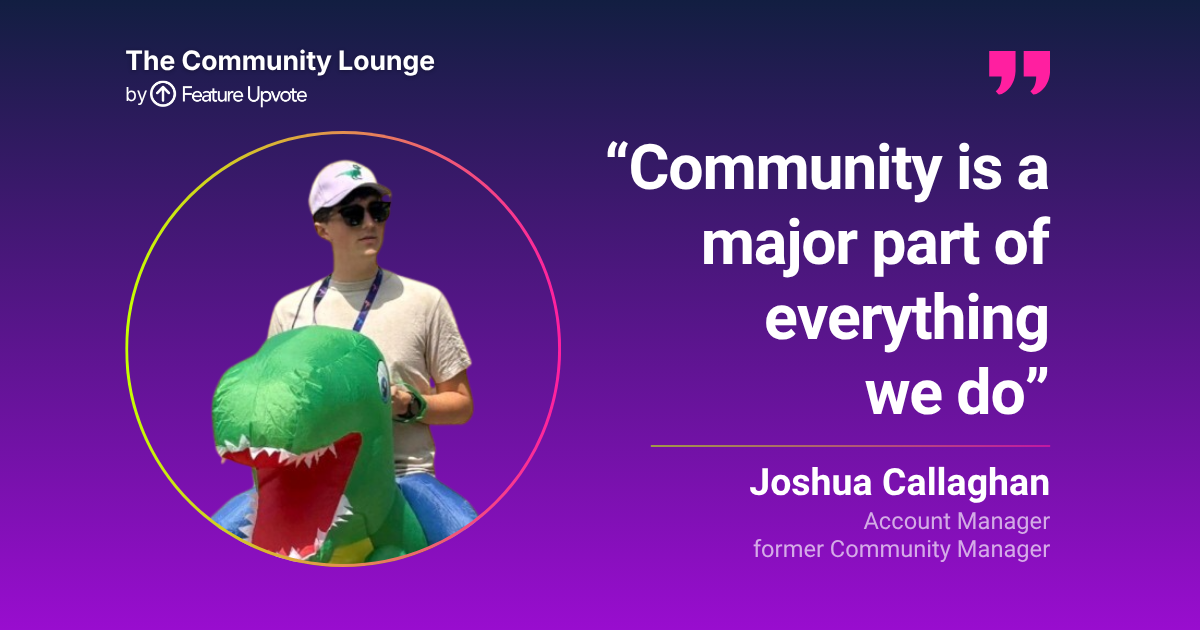
We chat about how Joshua got started in community management at just 14, the lessons he learned from moderating large online communities, and how those skills translate into his current role in B2B PR. He shares practical advice on measuring community engagement, using data to guide decisions, and why understanding your audience is key. We also discuss the differences between B2C and B2B community building, the evolving role of content, and even how wearing a dinosaur costume to industry events can help humanise professional spaces! 🦖
Games mentioned in this episode:
Other Shoutouts:
Find Joshua on:
The Community Lounge is brought to you by Feature Upvote – Painlessly collect feedback from your players. More insights, less noise.
Subscribe to the Community Lounge newsletter and get notified of new episodes and articles.
Transcription
Steve McLeod
What comes after being a community manager? Is there still a place for you in the video game industry? Of course there is, and my guest today is a prime example. Joshua Callaghan was once a community manager, but he’s now moved into another role, still in the video game industry. Welcome to the show, Joshua.
Joshua Callaghan
Yeah, thanks for having me, Steve.
Steve McLeod
Before we go into your community manager story, tell us what you currently do.
Joshua Callaghan
So I’m currently an account manager at Raptor PR where we deliver B2B campaigns for the games industry.
Steve McLeod
That’s a, it sounds like a big change, but let’s find out if it is. So let’s, let’s go back into history into your path and community management. So you worked for a while as a CM. How long ago was it since you were doing that?
Joshua Callaghan
It’s been good. This episode has been a good opportunity to look back at the CV. So I reckon it was around three and a half years ago, sort of when I moved sort of full time from community management into PR.
Steve McLeod
This silver-haired guy is going to say, look, you look really young. can’t even believe it was four years ago, three and a half years ago in your career. So did you get a very early start in as a CM? Why don’t you tell us, how did you get into being a community manager?
Joshua Callaghan
Yeah, no, so I’m 22 now. So I first started like exploring community management as like a concept probably when I was 14, 15. Sort of originally the route into everything in community management was on Reddit actually. So all voluntary, but I found that being a subreddit moderator was like a really good route into like getting into the games industry and like sort of starting within the, general like theme of community management.
And then I suppose, in terms of a more like formal role, I was the community manager at Lost in Cult, and that was sort of in late 2021, I joined originally as like a writer for their sort of online writing platform. And then in early 2022, I officially joined as the community manager where I applied some of that Reddit experience. And Lost in Cult, I should add, is a book publisher, a creative studio that creates lots of books around like concept art and video games and yeah, all of that fun stuff.
Steve McLeod
As I mentioned to you before recording, we’ve actually had another guest on the show who also wrote for Lost in Cult some years ago. Completely slips my mind now who it was, but it’s interesting that we see the people from the same firms come around. Let’s go back to Reddit. Well, what were you doing in Reddit? Were you like working broadly across various games or were you moderating specific subreddits?
Joshua Callaghan
Yeah, I think I was a big Reddit poster. I think when I was 14, I had quite an unhealthy obsession with karma on Reddit to the point where I’d look at like big news and I’d watch like Nintendo Directs and as soon as there was like a game announced, I’d screenshot it to be like the first person to post it on the game subreddit. I remember on like the, when there was a news of the Notre Dame being burned down and then eventually rebuilt. I shared that news on Reddit and was given like the post of the day award.
And like being 14, that was like the best accolade you could get to, you know, be recognized by the Reddit team for being such an avid poster. In hindsight, there was probably slightly better things I could have done with my time then. But no, I was really excited by Reddit and just enjoy being part of that community.
So I was always a big fan of like games and games deals. So I was constantly looking at like deals on like Fanatical, Humble Bundle. And then in 2018, I joined the ‘r/humblebundles’ subreddit, um, as a moderator, which was like a fan run, um, subreddit, um, and then later becoming sort of the head moderator. And it was really in that role. I say role, it was a voluntary position, but that taught me a lot about like community management.
Steve McLeod
Uh-huh.
Joshua Callaghan
Sort of managing a community. think we started as around 30,000 people. And then by the time I’d left, we’d gone up to sort of 70 – 80,000. So that was a really good way of, even though it was unofficial and it was voluntary in my spare time, a great opportunity to see like how you grow a community and sort of start exploring some of the concepts and things you do as a community manager.
Steve McLeod
So Reddit’s a little bit notorious for having some pretty difficult people in communities. Is that also one of the lessons you learned how to handle difficult people? Tell us about that.
Joshua Callaghan
Yes. Yeah, definitely. And I think the biggest thing for Reddit is just how alert you need to be as a community manager, as a moderator. We had sort of a small team of people whose job it would be to sort of check when comments are being flagged by other members of the community and be quite quick to respond and like take those comments down.
For example, because it was the Humble Bundle subreddit, we had lots of people trying to ask for like free games or trying to like sell their game keys, which was against like the terms of service. So even though it wasn’t toxic, it was like a constant case of sort of checking that those Reddit notifications to make sure we remove them.
Steve McLeod
Now, according to my maths, you were still of high school age. So how were you managing to be so immersed in the community and go to high school and do homework? What was not getting done there?
Joshua Callaghan
Yeah, that’s the fun part, I think. I think because I, by doing the Reddit position, I sort of saw that community management was something I wanted to do professionally. So I think that sort of served as a motivation for me because I knew that, yes, it was time and it was voluntary and it would be like time after school when I was doing it. But I sort of knew that that would help me with the next stage after I’d finished school.
So I think that motivation helps. And also the fact that I wasn’t the only like moderator on the subreddit. So we had like a team purposely across various time zones. So it wasn’t a case that I was always on. I did get time to sleep and focus on studies every now and then, which is a bonus.
Steve McLeod
That’s fantastic. I think that’s one of the things that burns out community managers is when they do feel like they have to be on all the time and it’s impossible. That’s so nice.
Joshua Callaghan
Yeah, no exactly.
Steve McLeod
Then how did that morph into working in Lost in Cult? That was just, they had an advert and you applied and they saw your background or did you get like, was it down another path? Tell me about that.
Joshua Callaghan
Yeah, so originally I was what was called a ‘Members Club Contributor’. So they had like an online sort of writing platform where sort of our audience would pay like a monthly fee and get access to some like podcasts and some blogs, articles like that. And I was originally a writer for that Members club program where I was writing like reviews of like musicals and films and things like that, contributing to podcasts, which was fun when I was sort of 16, 17 at the time.
And truthfully knew quite a lot about some game genres, but there was some like stuff before 2000 and before sort of early 2000s that I just have no idea about. So that was fun to bring that naivety, I think, to the podcast. But then there was an opportunity where they were sort of advertising for a community manager. And I knew Lost in Cult, I knew the team. They’d seen that I could write, which I think is a big part of community management.
And I applied from there, showed the experience with the subreddit moderation and then sort of went forward and was accepted from there.
Steve McLeod
Fantastic. Is there a particularly memorable positive moment you can think of as a community manager that you can tell us about?
Joshua Callaghan
Yeah, so my job really as a community manager was to sort of inform the community about some of the new book releases that were coming out and by extension sort of speak to them in Discord on Reddit as a way to like sort of keep them excited about the books that were coming and sort of showcase the team behind the projects. And sort of one of the biggest games I was a fan of was a game called Dreams, which is by Media Molecule, the same team behind like LittleBigPlanet and Tearaway games like that.
And actually, like by being a fan, it was a really great moment when one of the projects that we worked on sort of involved Media Molecule’s team, to feature them as part of one of the lock-on sort of book projects that we were doing. So I think that was a highlight to me sort of personally, because I was always such a fan of that game. And in particular, there was a community manager at Media Molecule called Tom Dent, who was sort of an inspirational figure. I’d watch his streams. I’d sort of see how he was engaging the community.
And sort of by working on that book and then sort of later attending the MCV Awards, I was able to meet him in person. So that was a nice like full circle moment, I think, sort of have a game and like a person that I looked up to and then be in the same like industry room as him.
Steve McLeod
It’s cool, isn’t it? And it’s something that the games industry really does. It actually is possible to meet people you see on streams and YouTube and whatever. Cool.
Joshua Callaghan
Yeah, yeah.
Steve McLeod
What about, what about the opposite? A time of a challenge you faced as a community manager that stands out in your memory. One of the not-so-happy moments.
Joshua Callaghan
Yeah, I think the benefit of Lost in Cult was that there were lots of happy moments. It was a really positive experience, but maybe more on the Reddit side. And you can tell I’m part of PR to have that answer.
Steve McLeod
I was thinking that.
Joshua Callaghan
But on the Reddit side… Exactly. No, on the Reddit side, I think because I was quite new to community management and I was never done any formal training or anything like that, I’d sort of made a mistake one day where, we’d arranged an AMA with one of the game developers who were in a bundle. We had all the community ready to join the AMA at a specific time that we posted.
But I had forgotten to check the time zones between the person who was in Australia, it turned out, and the rest of the community. And that was a mistake on me, where we had all of the community members ready to join this AMA, interview with one of the developers. And of course, they were asleep.
But we managed to sort it out and get it rescheduled. But that was a less positive moment for me, sort of trying to keep the community informed what was happening. Or truthfully, I wasn’t entirely sure where the guy was until a few hours later when he’d woken up.
Steve McLeod
Oh dear, dear. Well, I guess that’s a lesson you’ll never forget. In fact, when we were scheduling this call, you seemed to be really on top of the fact that you and I are in different time zones.
Joshua Callaghan
Exactly. Yeah, I’ve learned that’s the benefit that as you work and keep doing things, you learn new tips.
Steve McLeod
Yeah. So I’m, although I live in Spain, I’m from New Zealand and time zones are just a killer. It’s like this time of year, it’s 10 hours apart between here and New Zealand. No, 12 hours apart, and then in the winter it’s 10 hours apart because when they have daylight saving, we don’t and vice versa. I can never get my head around it, but enough about me and time zones. Let’s continue with you.
So, I know it’s been a while since you worked as a CM, as a community manager, but, but, what tips saw, how did you learn to do your job better? We’d like to share some practical advice and tips on this podcast. So is there something you can remember?
Joshua Callaghan
Yeah, of course, I think the, what I’ve realised sort of moving from community management into PR is that community management can actually be quite measurable. So I think it’s really worth like paying attention to the community to see like which posts get the most upvotes, which AMA gets the most engagement when a player is sort of most active on like Discord, for example, and sort of using those metrics to inform what you do.
So for example, if there’s a particular time that works best for an AMA, schedule it for then. If there’s particular people that sort of work best in terms of like the games that they’re working on or the roles that they have, then that’s worth considering too.
And what I mean by that is that if you’re a game studio that could potentially spot like members of the art team or members from the developer team, if your audience has a particular like affinity to hearing from developer voices, maybe spotlight that and basically look at like what the community is discussing the most and yeah, which metrics are the best and use that to decide the types of community initiatives that you do.
Steve McLeod
Okay. Okay. So one example of course, is the Australian for the AMA. It’s like, making sure that that that’s when people are online.
Joshua Callaghan
Yes.
Steve McLeod
Okay. I didn’t realize, I didn’t really think about using metrics for a community manager. I think of it more as a soft skills, you know, like communicating and being there, but this is really interesting to hear.
Joshua Callaghan
Yeah, no, I was going to add that I think one of the benefits of community management is that your success is sort of determined by community growth and community engagement and both growth and engagement are quite measurable stats. You can see like the rise of Reddit users or the rise of like Discord numbers and you can see like the number of messages being added.
So I think it really helps not to put too much pressure on yourself, but sort of check in, are those figures going up? And if they’re not, why not? Maybe there’s a new feature you could unveil or like a new developer voice to introduce. I think metrics are quite good at sort of keeping yourself accountable as well.
Steve McLeod
Okay. It could also reveal to you that you’re on the wrong platform, right? Like if you keep communicating on Discord and nothing’s happening, but then people are listening on, I don’t know, Reddit or Bluesky or something.
So what tips do you have for people wanting to become a community manager?
Joshua Callaghan
Yeah, I think for me, like, especially my experience getting into community management, not by doing like a formal degree or formal training. I do think, and I keep speaking about Reddit, but I do think Reddit is a really good way to get sort of some skills and experience in community management.
And because sort of Reddit is a voluntary thing to do to, to moderate on Reddit, it’s worth sort of choosing a subreddit to moderate in an area that you actually like enjoy and that you can be able to, spend some time without getting paid or sort of maybe a few extra hours in the evening.
I’d say that moderating on a subreddit is a really strong way to get into the industry. Because then you get to be in circles and meet people that you enjoy as a fan, which is fun in that regard. But it also means that you’re spending time with an industry that you really enjoy.
So yeah, my advice, maybe just to summarise all of that, is subreddit moderation is a really good way to get into the industry, learn the skills, speak to a community, and probably not have as much pressure on your role. It’s up to you to make the mistakes and learn and grow. There’s no performance reviews or things like that.
I think what I enjoyed with the Humble Bundle subreddit is that as part of that role, I was able to speak with the Humble Bundle team to collaborate on a few giveaways, a few initiatives like that. And that was just a good way for me to, again, meet professionals in community management and marketing, and sort of open my network a bit. So definitely I’d say like subreddit moderation is a good entry point into the industry.
Steve McLeod
So do you generally find it easy to become a moderator of a subreddit? Is there particular ways one can go about doing that?
Joshua Callaghan
Yeah, I think the big part is if there’s a subreddit that you’d like to be part of, be like an active member to start with. So like be involved in community discussions, post any news, sort of all areas like that. Because then when you eventually message like the moderator team and maybe ask if they’ve got any interest in having an extra sort of pair of hands around the subreddit, they can see that you’ve had like a good track record with them.
So I think it’s part of like being active just as a fan first. And then you can move into that sort more official moderator role.
Steve McLeod
And that takes away the fear that other moderators might have is that you’re just joining to promote something of your own.
Are you still highly active on Discord? Do you still have time in your life for that?
Joshua Callaghan
On Discord?
Steve McLeod
I’m sorry. Not Discord, Reddit. Are you still highly active on Reddit?
Joshua Callaghan
Oh yeah, no, all good. I’m not actually, I’m definitely a big user of Reddit. I still use it to like look at news and like movie reviews and discussions, but I’d say I’m less of a contributor now. The last time I posted may have been sort of two, three years ago. And I think that just comes with time, I think. I sort of like playing the games now rather than discussing them because that, yeah, that’s how I enjoy it.
Steve McLeod
Now we’ve kind of raced through the questions so far, but that, was intentional. I wanted to hear what you have to say, but I also want to make sure we had enough, enough time to talk about life after being a CM. So let’s start with the end. Did you choose, did you say to yourself, I don’t want to be a community manager, manager anymore. I want to do something else. Or did it happen to you just because of the way the industry is?
Joshua Callaghan
I mean the… I stopped because I wanted a degree. That’s the answer. Let me just think through my head how I’d phrase this.
Steve McLeod
Hahaha.
Joshua Callaghan
No, it was a really positive experience at Lost in Cult. And actually while I was at Lost in Cult, I’d also been doing an internship with Raptor, which was a PR agency at the time. And sort of through Raptor and like the government scheme, there was an opportunity to do a degree apprenticeship with Raptor. Because by then, even though I was like in community management and starting to get into the games industry, I’d still not had a formal degree as such.
So it was that opportunity to basically earn a free degree supported by the UK government and Raptor that made me sort of make that move from Lost in Cult into Raptor full-time as a degree apprentice. So that was the truth really, that for me there was an opportunity to get the games industry experience and at the same time sort of have a formal degree to my name. So yeah, that explained the move.
Steve McLeod
Okay, so then you stopped being a community manager, but now you’re working in a PR agency. And what was your role at first when you were doing the internship? I clearly don’t, guess you weren’t straight away interning as an account executive, right? You have to start somewhere a little bit lower than that, I imagine.
Joshua Callaghan
No, exactly. So it was an internship into a junior accounts executive role. So as a junior accounts executive, I’d help with lots of like the media list management and like events, research, social posts. So still a very like varied role. But it was lots of like the team sort of giving me different like instructions and briefs and sort of working on that. And then I think in PR as you become more, more senior and there’s sort of more agency over the jobs that you’re doing.
Steve McLeod
Okay. And was PR the choice, the one choice you had when you started the studies and the internship? Were there other things you could have done, but you thought this was the one that was right for you?
Joshua Callaghan
Yeah, so was at the time when I was like deciding, so it would have been 18 deciding what to do for my university studies. And there are a few different options. There was of course, go to university, don’t work, but enjoy like the university lifestyle and like live away from home. Or also there was opportunities that the UK does with the degree apprenticeship program, like various employers. I was actually offered a job with sort of a big fast-moving consumer goods company to sort of market washing detergent and potentially ice cream.
So your listeners may be able to decide sort of which company that was. But due to like sort of a family situation at home where I was sort of caring for my dad and probably the truth of having the games industry opportunity, I decided to go with Raptor. But for me, it was a case where I think doing a degree would have given me like more of an opportunity to apply my learning and also like get the lived career experience at the same time.
Steve McLeod
Yeah, and stay in the games industry.
Joshua Callaghan
Exactly that, Yeah.
Steve McLeod
So tell me about how your community management experience helps in your current work. Assuming it does.
Joshua Callaghan
I think, no, of course, yeah. think because the work that we do at Raptor is really focused on community, sort of our role as a B2B PR agency is to make sure that our clients are sort of active and sort of seen in a positive light in the communities that they live in. So for example, like a backend game company wants to reach like a community of tech people. A games publisher wants to reach like a community of game developers.
Community is still like a major part of everything we do because it’s our job to like help our clients reach that specific community groups. So I think that’s the first part, of having that community mindset, even though it’s not players that we’re reaching. Ultimately, everyone in the games industry are people, even though we have different like career roles in different groups, we’re still like a very social bunch of people. So it’s all about, yeah, reaching those spaces. And I think having that mindset is really helpful.
Steve McLeod
This is so true. I also spent most of my career not in the video games industry and what I really enjoy about it is how social it is, how friendly it is.
Joshua Callaghan
Exactly, Yeah.
Steve McLeod
When I go to events, it’s always warm welcomes and people greeting you like long lost friends and inviting you to mixers and so on. Yeah. You and I have run into each other in a couple of events too. And it’s been like that. I really like it. Tell me about the dinosaur. I’ve seen photos of you wearing a dinosaur in my own city of Barcelona too.
Joshua Callaghan
Yes, I can’t remember for how long it’s been, but I think it’s a legacy of my internship days where when I was like a more junior member of the team, I dressed up as a dinosaur once for Pocket Gamer Connects London, maybe 2022 now, possibly 2023, but a few years ago. And I’ve just held on to that title ever since I was an intern.
I suppose the whole idea of that again, like to bring it back to community is that I think sometimes particularly in like the B2B games industry, people in the industry can see like players or numbers or people as like metrics and business cases like how much revenue is this player bringing or what can this person offer for me in terms of like a business way.
The dinosaur is a way to like I suppose bring like community and fun back into it and show that like B2B marketing doesn’t need to be so boring and corporate, actually just to have some fun in the industry because the industry that we work in is really enjoyable.
Steve McLeod
You make a good point that it’s still people, whether it’s the players playing your game or the people who work in the studios and publishers who are your clients there on the tools companies, they’re still people. And I like that.
What about more practical skills that you may have from your CM skill that you use today to think of an example, working with certain software or doing podcasts and so on. You said you did a little bit of podcast stuff too as a CM. Does that stuff translate into what you do today?
Joshua Callaghan
Yeah, no, it does. And I think sort of the way that PR has changed since I started is sort of when I joined PR, which again, feels strange to say considering I’m only 22, but there’s actually been quite a lot of changes in the last four years or so that with AI sort of media outlets and media coverage isn’t the only way to reach communities these days.
Sort of, I think in the past, there was a big focus on getting like magazine interviews or broadcast interviews or sort of interviews in trade publications. And all of that is still really important, but it can’t be relied on as the only way to like, yeah, reach audiences.
So I think being a community manager has helped me realise that like, the webinars, the podcast, the video editing, there’s sort of different ways that you can bring like a campaign to audiences. So for example, I’ve helped clients in the past with, webinars to reach like a community of, of game publishers. We’ve done similar with like video content to again, sort of bring that, that human voice to, to LinkedIn, for example.
There’s, a big trend towards like AI, generated content where everyone, if you go on LinkedIn, you can see lots of posts with like Em-dashes and like, ‘Not Just’ formatting. So I think there’s a big move towards making sure we present people like as, as people, as individuals
But I think, video is a big part of that because it can show like the human experience, the people behind the accounts, and you can’t replicate that with AI to have someone on video speaking to camera with their potential like flaws as well, I suppose. It brings like the human element to it.
Steve McLeod
Yeah. Yeah. A good answer. Let’s hope that stays like that for a long time because some people will say, “Soon the AI will be good enough to do anything, including videos that seem more human, including flaws.”
Do you ever like crave, do you ever crave the community management days? Do you ever kind of wish you were back there again?
Joshua Callaghan
Yeah, I think sometimes because we’re a B2B focus, like I mentioned before, sometimes the industry can see gamers as sort of metrics, like how do we increase our ARPDAU, who are like the whales in the industry? I think that’s the side sometimes that I miss sort of seeing gamers as gamers rather than just like numbers on a spreadsheet. That’s the biggest part.
And again, because community management is a community, like a relationships business, I suppose. It’s sometimes a bit disheartening to see people in the industry treating players as just like revenue figures and metrics to bring in more money rather than like individuals wanting like specific games. That’s the biggest sort of difference I see between B2B and B2C.
Steve McLeod
That’s interesting. I feel that community managers are often the first to be let go when a studio or a publisher is having hard times. It’s a really unstable role.
Joshua Callaghan
Yep.
Steve McLeod
I feel, I don’t know much about PR, but I feel that it’s probably a far more stable role. So I don’t want to just be negative and say like, know, CM gave you more chance to do these things, but both for you and for the listeners. I want to say there’s also a lot to be said about roles other than being the community manager, even if community management is your passion.
Joshua Callaghan
No, exactly. Yeah, and that’s it. And I still get to apply lots of the community management experience in the role. So some of the work we do is for a platform that’s providing tools specifically for community managers. So as part of that, I get to write sort of blogs, product details, yeah, for leadership pieces, all about community management as part of that. So it’s not that the whole like concept of community management and engagement has completely like been lost in my role, and it’s still big part of what I do.
Steve McLeod
Joshua, thank you very much for telling us about this. I think it’s really nice for other community managers to hear that you can stay in the industry, you can do something quite different, still use your CM skills and maybe have something that fits when you’re in a different stage of life. ⁓ Our needs and life change through time and sometimes one role is better for us than another. There’s one more question I need to ask you and this is by far the most important question.
Steve McLeod
What game have you been playing lately?
Joshua Callaghan
Yeah, I’ve just started playing High on Life 2, which is just so sort of bizarre and strange that it feels like quite refreshing. So High on Life 2 and then also Hades 2 in a bit of a sequel mode at the moment.
Steve McLeod
What is High on Life 2? I don’t know High on Life 1, tell me about it. What do you like about it?
Joshua Callaghan
It’s like a first-person shooter, but your guns talk to you while you shoot. So it’s by some of the team behind like Rick and Morty, Squanch Games is the publisher. It’s just very, yeah, very funny, very like irreverent. And it just feels completely different to what I’ve played in the past. So I think that’s quite refreshing.
Steve McLeod
Okay, so let’s go to some of the Rick and Morty style of humour in the game.
Joshua Callaghan
Yeah, and like you could go up to a, an NPC for a little bit and just stand next to them and they’ll just talk for five minutes nonstop. You can tell they had fun in the recording booth doing it.
Steve McLeod
That’s good. I like it when games don’t take themselves too seriously. And do you find much time to play games or life is too busy?
Joshua Callaghan
Yeah, still finding time. I think Steam Deck is good. The Switch 2 is good, especially for commuting. But yeah, life is busy and it’s probably only going to get more busier as the sun starts to arrive in the UK.
Steve McLeod
Good and you also travel a lot for work, right? And I guess this Steam deck has become the device of choice for people who need to travel for work in the games industry. You see people on aeroplanes with them coming home from events.
Joshua Callaghan
Yeah, no exactly. think the Switch 2 sometimes just takes the edge because it has slightly better battery life, but no, both of them together, they’re a good combination.
Steve McLeod
Excellent. Joshua, that’s all we have time for today. So thank you again for being on the show.
Joshua Callaghan
Thank you for having me.
Steve McLeod
Where can listeners get in touch if they’d to know more about what we’ve discussed today?
Joshua Callaghan
Yeah, LinkedIn is best for that. It’s the same name as what’s on the recording. So Joshua Callaghan. And you can find me by looking for the profile picture of the dinosaur.
Steve McLeod
Okay. That’s a nice callback and I’ll make sure that we have a link in the show notes to your LinkedIn profile as well. Okay. Bye Joshua.
Joshua Callaghan
Yeah, thank you. Bye, thank you.
Steve McLeod
Bye everyone.