
Subscribe to The Community Lounge podcast
(You can also watch this episode on YouTube.)
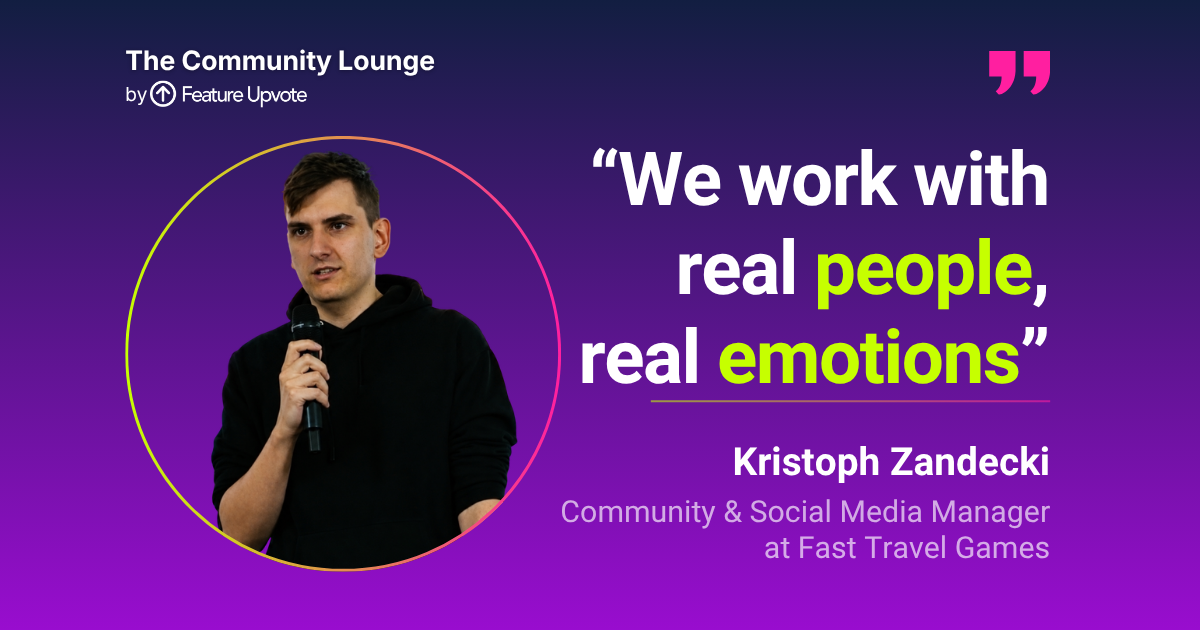
Today’s guest is Kristoph Zandecki, a passionate community manager and marketer in gaming based in Poland. Kristoph was seconds away from becoming an English teacher before a Junior CM offer came in at the last moment. He’s spent the majority of his career in the VR space, working with studios including Incuvo and VR indie publisher GameDust, and has also built up broad experience managing communities for everything from indie titles to big-brand IP, and from adult players to children.
We talk about what makes VR communities so distinct — smaller but intensely dedicated, and quick to spot anyone who doesn’t really know the space (never call the headsets “goggles”). Kristoph shares how he immersed himself in VR culture, learned the hard way about motion sickness, and watched the platform shift as Meta pulled back and left its community feeling abandoned. Kristoph also walks us through his approach to revitalising a dead Discord: what to keep, what to cut, why you should expect a wave of members to leave when you start making improvements, and why that exodus is actually a good sign.
Games mentioned in this episode:
- Green Hell VR
- Batman™: Arkham VR
- SUPERHOT VR
- Half-Life: Alyx
- Kingdom Come: Deliverance II
- Clair Obscur: Expedition 33
Find Kristoph on:
The Community Lounge is brought to you by Feature Upvote – Painlessly collect feedback from your players. More insights, less noise.
Subscribe to the Community Lounge newsletter and get notified of new episodes and articles.
Transcription
Steve McLeod
Today I’m joined by Kristoph Zandecki. I really like the way Kristoph describes himself on LinkedIn. He’s not a community manager, he’s a passionate community manager and marketer in gaming. Welcome to the show, Kristoph, our passionate community manager.
Kristoph Zandecki
Yeah, thank you for having me. It’s great to talk with you.
Steve McLeod
It intrigues me that you’ve done community management work for VR games and I hope we’ll be able to we’ll have time to chat about that, about how VR communities differ from others. But first, let’s talk about how it began for you. Tell me, how did how did you get into community management? And you can you can answer in a sentence or you can spend ten minutes. It’s up to you how much detail you want to answer here.
Kristoph Zandecki
Yeah, well, actually, I studied at university. It’s a very weird kind of major stuff. It was because it was English philology as your main kind of course, but they had a…
Steve McLeod
Sorry, English zoology? A philology, like linguistics.
Kristoph Zandecki
Philology. yeah, better, English linguistics, yeah. So I studied that, but they had the like specialization for that type, for that course was localization in games. It was like our main point. So I also learned how to maybe create some games in Unreal Engine, some graphic design on the side.
But it was after I finished my studies, I also needed to get some practice hours, like internships somewhere just to get them kind of approved by my university. And at that moment, I was interviewing two sides. I was interviewing for gaming stuff and I was interviewing to be English teacher, like for like one hour a day something English teacher.
Right at the moment, I got two offers at the same time. I got an offer for the Junior Community Manager and an offer to be a teacher at a private English school. And I’m glad I chose the Junior Community Manager because even though I love English and I love linguistics, I would not be able to teach, especially like that and having to just…
Yeah, just not, not vibing with that that much. Um, but yeah, that’s how it started. It was my first job, uh, but it was already kind of a lot. Uh, it was a Junior Community Manager, but it was. We in the span of a year, the company was cycles like six CMs. Uh, so the turnover was very high. Um, and it was a community manager for everything.
Even though I was called community manager, I had to do Facebook ads, marketing campaigns, press releases, community management itself, recording trailers, also streaming on Twitch. Yeah, that was a lot of happening. It was already an established community for our simulator game about gold mining. So it was a plus that people already were there, were interested, but even the community was like, “Another one?”.
So I didn’t stay there very long, whatever I can say about the company, about the structure there, how I didn’t like it, I have to admit that just because I got the opportunity, just because I got to start there, it really like kind of made it much more easier to find other roles. Just because I met new people, like literally my next job I found at Incuvo for VR games, how I started VR games.
It was because I knew someone who moved companies. It’s not like they hired me, but just some, it was not cold messaging anymore. It was warm somewhere. And I think that’s the most important part that I learned there is that even the connection that anything were important, were starting to become important once I wanted to move out from that company. So even though it was very hectic and it was very hard and I had to do a lot of stuff I didn’t even know how to do.
It really showed me a path I could go forward because nobody talks about community manager as a role that you can take pretty much, especially here in Poland. Right now it has changed. But when I started five years ago, I knew about marketing personnel, about PR managers and the dev side, but there was no mention even during my studies that there’s something like a community manager, social media managers in gaming. So just that it got hands on experience with that role. And I learned what I can do, where I can grow, that despite all the challenges, it made me really appreciate my time there.
Steve McLeod
That’s a fantastic story. I think so close to becoming an English teacher and almost being saved. But I think you also mentioned something well, you did mention something I think is very important in the video games industry, and something that’s kind of surprised me, how much it depends on relationships and who you know.
And once you’ve had one job and proved you can do it, even if that studio’s in trouble, even if you don’t stay there very long, you’re gonna see people in your next job and advance and so on. And they’ll if you if you’ve proven yourself in that first chance, you’re so much more likely to get an opportunity next time. And obviously that happened.
Kristoph Zandecki
Yeah, exactly. And it keeps happening actually. Most of my roles that I managed to get, even though I was recruiting for them, most of them were like, I already know you or I saw you or whatever. So it’s like, it’s already much easier to talk through that like we’re not strangers like from the beginning.
Steve McLeod
Ha ha. Yeah. Yeah. It’s also interesting that you didn’t know about this community management position or work because I’d say at least the way I see it, there’s a very, very successful Polish game, that’s the Witcher series, which I think they have excellent community management. They really are like a standout example for the whole industry. I guess their community management’s not always in Polish, Poland itself, but yeah. I had somebody on the show who wrote for on The Witcher Games.
Okay, should we talk about VR, what it’s like doing community management for VR games and how that differs from normal well ‘normal’ other games.
Kristoph Zandecki
Sure. So I’ve been in the VR space for like the majority of my experience. So like four and three years. And it’s also, was already a learning curve for me just because I never tried VR before going to the recruitment talk. And literally my recruiter who was my marketing manager then literally showed me VR as it was. it was five, four years ago.
Steve McLeod
Wow. Why do you put a helmet on your head? put the VI headset on. Wow.
Kristoph Zandecki
Yeah. Yeah. And it was, very interesting. I admit that after a month of starting the job, I bought myself a headset to have for private use. And it really showed a difference that there is a barrier of knowledge, more than barrier of technology. That is more about people not knowing how much the stuff has grown. Because VR started in 2016, I think, 2015.
And back then, it was just a gimmick. was something you go to arcades for, you have some simulation stuff and that’s it. But especially even in 2021, the games were already kind of established. There were a lot of good games, good IPs put forward, right? There were even Batman games on the platform. So it’s not like the games were not there. It’s just the gaming community as a whole and people just didn’t know that this is a platform for gaming. So I think that also came with the community management perspective.
That the people who actually interacted with what I did with my community or my social media posts, they were already in the know of VR. They already knew of the platform. They knew of other games. So it was very smaller niche community, but they were very more dedicated. They were excited for a new game coming out to VR just because they’re like, a new game, something exciting to play, that people actually care about it, right? Because even…
Steve McLeod
Uh-huh.
Kristoph Zandecki
On Steam it’s just like, yeah, another game, why should I care? But VR players are kind of different and that has been changing now, but they were very different that they really cared if you just showed up. Like if you showed up with a quality product, they wanted to listen to you just because there were not that many games on VR and not that many like quality games there. People were more likely to listen to you just because they’re like, oh, there’s nothing on my headset, I already bought that. So I like, I’m interested in that. So…
But on the other hand, it also shows a problem that you cannot be not in VR and be there because they’re very tech savvy. Not all of them, but they understand differences between headsets. They understand how the VR works, how to call it. I think one of the first issues that I saw was that in Poland, we call those goggles. We have a word for it that’s ‘gogle’. We call it goggles. So they are Quest goggles or VR goggles.
Steve McLeod
Yeah.
Kristoph Zandecki
But this was a very bad word for the VR community because VR goggles was something used as like a marketing term and it was more regarded like the cardboard version of VR. So the one that’s only like for marketing or that’s very cheap. So I had to learn very quick that no, it’s called a headset and it’s a very, particular about the word, right? Because they care about the space and they don’t want to see any outsiders in it.
So when they see a sign that you are not really into the VR, that you are not really understanding them, they won’t listen. So I really had to, I didn’t know before the job that I took at Incuvo what VR was, but I had to learn very quickly. But that also showed,
Steve McLeod
And how did you learn? How did you learn very quickly?
Kristoph Zandecki
I insulated myself in those communities, right? So I had my, we had our games Green Hell VR. So I played a lot of this, but also joined all those different communities for VR games in general, or some particular ones. And I play those games. I see how they were interacting with people. I saw how, especially in VR, there’s a problem of motion sickness. And some people get motion sick. And I was very motion sick in that.
Steve McLeod
Ah, okay.
Kristoph Zandecki
But the thing is that I am actually glad I was, because during the process of trying to get that sorted, because you can actually get that sorted, don’t know about it, right? They feel like, “I get motion sick in VR. I won’t be able to play ever.” It’s not that simple.
Some people wont, but it’s very easily, not easily, but it’s very, not easily, it’s very common for people to actually get rid of that motion sickness. Maybe not completely, but that can play games. So I learned all the different tips and tricks. So if whenever I, the newcomers were around, I just, and they were like, this makes me motion sick. I have tips for them ready, and the community.
Steve McLeod
Okay.
Kristoph Zandecki
So you have to have a fan in front of you. You have to have a window open. You have to chew gum. And the most important tip, I think, is that don’t force yourself because your brain will then treat VR as something you force yourself to and they won’t like it. Like your brain, you have to sometimes like alter your brain chemistry to force them into liking VR so that they don’t get motion sick. Because if you push yourself to that first motion sickness, then your brain will be it always be that hard.
But when you take a break from that and just get back later, it gets much easier. And I think that’s something that I wouldn’t learn by just reading about it. I had to experience that VR. I had to really get into that community and really get into why they care about this platform, right? And one other thing that’s very important for the VR community, especially right now how it’s changed, is that many platforms stopped caring about them.
Steve McLeod
What do you mean by that?
Kristoph Zandecki
Because before it was Oculus, Oculus Quest 1, Oculus Quest 2, Rift, that was a different company. And people were trusting that company, there were other competitors like Pico, but it was that the Oculus Quest was the one that was more important because you didn’t need to have a strong computer, you could play on standalone. But then it got acquired by Meta.
When in their whole metaverse stuff started and even though in the beginning it was looking great for VR new IPs new money new everything after a year or while it just went downhill in a sense that Meta itself. I don’t want to buckle anybody, you know personally a Meta, but it just showed that it was more of a money-grab than they actually care for players and they felt it.
Steve McLeod
Uh-huh. Okay.
Kristoph Zandecki
They felt it very strongly and this sentiment has been growing to this day, that that’s why they are more bitter about the platform, about the games, and they’re actually more critical of them right now, just because they feel very left alone. That’s why it’s very invigorating to see Steam coming out with Steam Frame. That is very exciting. We don’t know when it’s going to be.
But this is something that people wanted for a long time. A competitor to Meta Quest that you can play standalone. And Valve is already pretty trusted when it comes to VR games, like many people when you say, what’s your favourite VR game, they will say Half-Life Alyx.
And it’s understandable. It’s a great game.
And it’s like, especially in the time it was created when VR was really a child kind of platform that really showed what it can do, the potential of VR. But that’s how it has grown and how it is right now. So right now it’s in the middle space like…
Especially now at Meta, they had layoffs. They laid off their pretty much entire internal team for VR games. So it’s really weird to see that. The colleagues I had, all the people I knew at Meta just leave like that one day. And it’s really sad to see the community just not knowing what will be next. Will the VR die? It has been announced dead for like five times I’ve been working. So it’s like, we don’t know, but I think the Steam Frame itself may help here.
Steve McLeod
Yeah. Well, let’s hope Steam- I mean I feel like Steam will commit to the long term. Even if it’s not a great success at first, they’ll persevere. So a little I have a little story about Meta’s sudden reversal and all of this. I went to the PGC Pocket Gamer Connects event in London in January, and Meta was like a diamond sponsor or a gold sponsor or something, and they had a booth.
But between the event being announced and set up and actually happening, Meta decided we’re done with VR and with the Metaverse at least. And nobody turned up from Meta. So their booth was there empty for the whole event, which was actually quite convenient because you know you at those events you’re on your feet for a long time, it’s hard to find a place to sit down. And people just used started using the Meta booth as a place to rest, get out your computer, do a bit of work and so on. So in a way I was kind of grateful for it for it. But yeah, it really it really looked terrible. It set a terrible, terrible message from Meta to just not turn up.
Kristoph Zandecki
Yeah, and I think the community sees that. They see that very well how what Meta is doing, how the platform is performing, how it’s happening. Like you can say right now that the platform, even though Meta says not for children, it’s over 13 years old, that they are working on moderation. The platform that you see like four years ago when there was full of new titles, horror games, what have you.
The very unique games like Superhot, very big IPs coming to it now. The top Meta Quest games are for children, free-to-play and based on gimmick movement mechanics. I don’t say they’re bad games. I think they have their niche and have their use, but just seeing the platform leading into that, it’s really, it’s hard to actually know now convince people to pay for more elaborate experiences.
Just because they’ve been burned so many times in the past for quick cash grabs by people just seeing a VR title and be like, yeah, that’s new thing we have to try and then not leave any dev time or any dev budget for it. So that’s why nowadays it’s harder to actually convince people in the VR space to care.
Steve McLeod
Yeah. That’s a shame. Hey, this is a good point to segue into another topic I want to discuss with you. You mentioned how the meta products are now becoming more popular with children. You mentioned that you have experience with a wide range of games and studios, big games, small indie games and triple-A brands, and children versus adults. And I’m really curious to hear how community management differs when the players are children and when the players are adults. What do you have if you can tell us there?
Kristoph Zandecki
I think the most important difference is understanding the empathy behind it and how you present the community to them. What I mean by that is that children communities require much more moderation, require much more hands-on experience, can’t handle operations on the server, than adult ones who can sometimes do what they want on themselves and they understand some social, know, social sabre-vive or whatever you call it.
The thing that is important is that children and especially in now age, in today’s age, have less attention span. And whenever you create events, whenever you create a structure on Discord, they need to be more straightforward. They need to be to-the-point, they click, they get there, they don’t, they usually ignore you. So in that regard, you really have to be ingrained in that community.
The community will be much more active than adult ones. You can have the same amount of members on Discord, but the children will be much more active, much more messages. But how you talk with them is much different, especially in the moderation. Because when you create a space with their children, you have to make sure that they are safe. You have to make sure that whatever you do, you don’t go into the territory that they can be hurt by anyone.
But that’s why the rules are more strict. That’s why I have to have moderators earlier than in adult servers. That’s why I have to make sure that whatever we do as a company, whatever we do as an agency, we don’t require to DM people, to DM those children, to have all the communication very openly so that if anything comes back to us, we have all the receipts in open and everybody can see that.
And also they see me like as a moderator, as a committee manager, they see me more of a figure of authority. Like they see me that I am the banhammer or I am the person who they want attention from. And that is very risky. That’s good that they want to listen to me most of the time because they understand what I’m doing and that I am the one giving them information they want about the game.
But that also can lead into parasocial relationships that they don’t really understand that I am an employee of a company and I’m not there to be their friend.
Steve McLeod
Yeah, yeah.
Kristoph Zandecki
And that’s really hard to understand when to shut off, right? Because I’ve had children DM me just because they want to know something about the game. They don’t know me, don’t know my age, anything. So I really have to shut them down very quickly so they don’t form those relationships. With adults, it’s very, very different. The events you create can be more elaborate. They can be longer events. They can have more things to do just because they understand that if I create a contest and there are three steps instead of one, they manage, they understand and they don’t get that much distracted.
They also don’t need as much moderation because there’s less messages and people check themselves. In like all the demographics, I’ve seen that whenever I was, when somebody did something bad, right? And I said something about it, the next day I could see someone, not even a moderator say the same thing to the other person using my words. So they understood more clearly. I didn’t have to repeat as much myself.
And they kind of moderate it themselves. It’s not always the case. It depends on the type of game, because competitive games tend to be more toxic in the community. But overall, it is much more lenient on the events. And also the language I use can be much longer and I can give much more information. Because if I write a long-winded message about how we care about the community and I send it to adults, they will understand, they see all the nuance we put into it, children will be like, where’s new content? Why should I care?
So this is also about the attention span that we can, that adults understand delays, adults understand that some things take time, that they are patient about, that children are not. So especially when I give contests, when their children, want the results on the hour the contest ends. Adults understand they will be like after a day or two, they are aware of the results or who won.
Steve McLeod
Yeah.
Kristoph Zandecki
So other than that, and obviously, making sure your language is on brand. I think it’s also just coming first of all empathy and understanding who you’re dealing with because adults won’t treat me as a point of authority. They treat me, they understand I’m an employee and they will treat me as such. They will not treat me with respect unless I show up for that respect. And they will not kind of, because for children, I can sometimes say some things in a roundabout way, not say sorry because obviously I cannot say sorry for the whole company sometimes.
So I can have some language around that, crisis management skills used there and they will be fine. But adults have a sensor, they sense something that I don’t want to say. And it’s very harder to fool them. It’s much harder to fool them.
Steve McLeod
That’s really interesting. I really value the amount of expertise and you have in this. It’s fantastic. Where do you see the line where the people stopped being children and needed to be treated like children and now they can be treated like adults? Do we just say it’s like a particular age or is there something else that where the community is now you can treat them like adults?
Kristoph Zandecki
For me, for the sake of ease of my work, I just treat them as Discord. If Discord thinks or the community thinks they’re like the platform I use, think they’re adults, so usually 18 or if somebody’s 16 years old, then I treat them as such. But it also comes with experience with the community, right? Because I can come to a community and be told our demographic is, I don’t know, 30 year old men, right? And then I come to the community and there are children there.
So it happens that sometimes the product managers mismatch what actually players look like, right? There are games who were, even though they were targeted at adults, they get into the hand of children. I am not the one responsible to be like, please don’t play that game. That’s not my job. If they play the game, they join the community. That’s not my job to tell them not to play that game. It’s my job to make sure they’re safe in that community. And especially in those cases, when there’s an interlap between adults and children, I have to make sure that people understand that there are children on the server.
Because in the rules, in everything, and that there’s a proper way to report people if something happens, someone DMs someone, because if we just leave it rampant, it will not only drew a wedge between those two demographics, which we don’t want, but it also leads to someone being hurt, which essentially would not want that attached to me as a community manager or to our brand or to our game, right? So I think…
Steve McLeod
Right.
Kristoph Zandecki
It just, the matter at hand of that is just seeing that what the community actually is and then adjusting to that, right? Because I, even though some people say they’re adults, I can see how they type or how they act that they’re not. So it’s just about not taking the word of either my team. Sometimes it’s hard, but sometimes I have to see myself, but also of the people who I’m interacting with and see how it goes, right?
Because I cannot really trust people on the internet.
Steve McLeod
This is very true. There’s the famous saying on the internet no one knows you’re a dog, based on the very early days of the internet. But it’s true, like there are children pretending to be adults and you know, finding ways past age checks and so on. Uh-huh. It’s a difficult situation. I’m glad I don’t have to deal with that.
Kristoph Zandecki
Yeah, that’s why whenever I do that in the beginning, it was much harder. I didn’t understand it, right? I had people DM me, was talking with them and that led to some situation where it went too far. And I didn’t know it went too far, but because of the situation I learned along the way. And right now I am very strict about not messaging people when it’s not needed, not invading their privacy, not collecting their data. And if we are collecting the data, knowing what we can collect, how can they maybe not want to collect it?
They can choose something else, and just being very mindful of that because I am in the end a representative force of the company or of the game and I am one of the most front facing people. So they need to have a good interaction starting with me first. Otherwise they will just form their whole opinion from the company about only me. So there’s a lot of pressure on my shoulders with that, but it’s also makes it much easier because I just put on a mask.
It’s not like I don’t, I don’t, I am not genuine in my interaction. I just have more, I have to grow thicker skin when I’m at work and I have to have a mask of when interacting with people just so I don’t get hurt and they don’t get hurt.
Steve McLeod
Kristoph, we’re running out of time, but I’m thinking that we might stretch this a bit longer. Are you in a rush to leave? Do you need, somewhere you need to be?
Kristoph Zandecki
No.
Steve McLeod
Okay. I think because there’s one topic I still want to discuss with you, and I’d hate to miss out on this. So something you mentioned to me in advance is that you have experience in revitalizing a Discord community or Discord communities, how to revive them and not lose your mind while you’re at it. And I’d love to hear your point of view on that. What do you do when you inherit a Discord community that has a lot of people in it but nothing’s happening. Tell me how you go about that. That we’ll make this our last question before we do the final, final question.
Kristoph Zandecki
So it happens more often than you may think because some, especially for a more established company, they have their game, they have their Discord, just put the Discord on the store page or in the game and just leave it as is. And then you have to come in and you see the mess that nobody understood what’s happening. Nobody knew how to deal with that. So the first step is to see what the community is, right?
See whatever you can salvage. you can see a channel that’s being interacted with, leave it. If you see any bots that people are using, just leave them at the server, right? If you see people who are active, talk to them, see who they are, see what type of people they are, and maybe they can be used as moderators because if they’re active in a dead server, that is dedication that I need to see why they’re dedicated. After that, I really have to go back to drawing board and see how we can change the structure.
How I can change the rules to make them more straightforward or maybe more safer for people to interact with. If there’s an toxicity in servers, because in that server, even though they’re dead, they can be toxic people who just want to talk bad about the company or whatever. So it’s just about seeing how I can deal with that through the structure and through my interaction with the community, how to rot those bad apples from inside out.
Then it is about seeing how it can go on brand, right? Because most of the Discord that had this problem, they’re also not on brand. They’re just a Discord with the name of the company, of the publisher of the game, but on the inside, it’s just a general off-topic voice channel, no sense of belonging or nothing, right? And in this court, it’s very important, it’s pretty vital for the sense of belonging to start from the get-go, the onboarding language, the channel structure itself.
How you call those people. I always say to people that they need to have a role for all the people in Discord, just to have a way to address them and be like more on brand. And that’s something that I had to talk with my team about. How was the branding of the publisher? How I can convey that in my messaging, especially since when I joined the company, I had no idea. I just said, okay, it’s a gaming brand. I know games, but it’s a different gaming company. So I had to learn that on the go.
And after that, it’s just about executing the structure and executing how to provide the value. Because Discord servers die for two reasons. Even the devs died, not literally, but you know, the studio closed, the games closed, nothing is there. Or the Discord was providing them zero value. The Discord was used like a marketing post. It was used as a informational dump. Nothing of value to them. Yeah.
Steve McLeod
Yeah. Yeah. There was one way, right? It was from the studio to the players.
Kristoph Zandecki
And that’s the first problem I need to solve is to create events, create value, create people a reason to join the Discord, actually interact there. It can be through all through events, it can be done through events or like onboarding, but it can also be done through some in-game stuff, right? So I have to talk with the team here. But the most important part is to try to stick with it for a while.
Because when I joined the GameDust, and they were already known publisher in the VR space, but they were still a VR indie publisher. So was a niche within a niche. So a niche on niche. So they have a very small community, but even then after I made those changes, people started leaving. And that’s bound to happen. And in the beginning, I didn’t understand it because I’m like, I made those changes. The Discord looks better. I can see that, what I did have value to the brand. It looks more on brand.
It looks more useful, but people are living. And that’s the case of the servers that people forget about them. You can have 200 servers, or even more with Nitro I’m not sure, on Discord. So people forget about what Discord they join, especially if sometimes they just like gleam campaigns, join Discord to win something, they forget about it. So when you start doing stuff, when you start pinging people again, when you start creating events, they remember at this course that they joined a year ago, like, I don’t care, I’m out.
And that is actually very valuable to us because we want people…
Steve McLeod
Yeah, how is that valuable?
Kristoph Zandecki
That’s valuable because that shows us what people joined only for whatever was happening back then or whatever for a game that we made like a year or two ago. And that separates those who were not kind of interested in our products and the people that are or in our branding, right?
Because if we started interacting in the server more and started doing those changes and people, the people who stayed that made them that they cared enough to stay. Because if some people left and leaving at this server is very simple. So it’s just two clicks away. So if they didn’t leave, that means that there is something right. And I just stick to my guns and I said, okay, I will try for a few months. If it doesn’t go that way for a few months, I will check the analytics on this core dashboard. I will see how retention is going.
And the thing is that after a week or two, after this big exodus of people from the Discord, I saw that the retention was growing up. So the percentage of people who joined and then stayed after that time was much larger. Then I saw that people were actually joining, the same amount of people left and joined. I was like, okay, we’re going into neutral territory. I was like, okay, let’s continue that.
And after that while we grew to the size we were at the beginning, in like half a year or something like that, and people were starting to interact in these channels. There was, even though the number of members were the same, the numbers looked the same on like the growth tab on Discord, the engagement, the tab, the communicators, how many people messaged, how many channels were visited, they grew exponentially, they grew more and more.
Steve McLeod
Wow.
Kristoph Zandecki
And I think that’s the most important lesson when I try to revive that channel and that server is that you really have to grow a thick skin when it comes to numbers and to defending yourself, right? Because I am very glad that my team understood and trusted in me, even though I was a newcomer, it was my big first task. The team at GameBus were very welcoming and they understood how hard of a task that was. And they just trusted me and was like, yeah, let’s go with it.
I know in some, especially bigger companies, it might be much harder to actually convince people that what you’re doing matters because they see numbers, they want to report on the numbers and they’re going lower. So they think you’re doing a bad job. It’s not that straightforward, especially when working with real people, with real emotions, with real loyalty. So it’s more about how, what you can grow from that and how you can also develop as your own person because that also made me less scared to risk sometimes because when I see a risk and I can see it the effect in months rather than days is much more valuable to me than just one one-time engagement spike, right?
But revitalizing is never easy especially trying to have especially when you have like a brand rather than a game it’s always harder to make people care about a whole publisher than one game but it was really it was really kind of rewarding for me to see those people interact, actually starting to use those spaces.
Steve McLeod
So later this year or maybe early next year, I want to add to our website a guide of for community managers on how to best use Discord. And this is so inspiring. I think we’re gonna have to include some of these tips of yours on how to resurrect or revitalize the Discord community there. And the insights that management want to see numbers go up, but you are gonna see numbers go down for a while. I think that’s a really important insight. And it knowing that’s the case, you can then tell management, look, this is what happens when you revitalize it. We do lose people. That’s great. Great stuff. Thanks, Kristoph.
Kristoph Zandecki
Yeah, and then like one thing I can add to that is that it’s not only useful in revitalizing communities, it’s also useful in work overall. That when you make changes, especially when you join as a new CM to already established community, doesn’t have to be that. Well, especially when I was working on the agency, I am always an outsider, right? I’m also joining an established community. They hate, most of them hate change. And you are bound to see negative standards.
It’s something as simple as creating for one server. I created just a usual one role for everybody in server. So we have the sense of belonging from the start. And they hated that. They hated everything about it. The name, why do we need to have it? Why is the colour like that? Where there’s no icon? But after I’m on there, they just got used to it because sometimes people just have to get used to changes. People are people. Sometimes they hate change. Yeah.
Steve McLeod
Yeah. Exactly. Most people hate change or something they’re familiar with. But most people also get used to the change pretty quickly. We have completely run out of time, but there is still one final, you might even say the most important question. What game have you been playing lately?
Kristoph Zandecki
I’ve actually been playing Kingdom Come Deliverance 2 the most, which is kind of funny because I tried my fiancée, played the first game, didn’t like it, but after the second one came out she played that and he loved it. He loved it more than Expedition 33, which can tell you a lot. He still loved it, they’re very equal to him, but you know.
But then I tried playing again the first game because I’m the type of guy who wants to play all of the games in the series before going to the most important one. So I tried to play it and it was not for me. I played for longer, it was not for me. So then some time has passed and my fiancée was like pestering about, “You need to see this romance!” because there is a gay romance of the main character with Hans and…
He was, “You need to see it, the best one I’ve seen, the best one, whatever.” I’m like, no, maybe I will play it, maybe I will play it. I’m always like that. I’m always, and he gets annoyed about, very quick, very often, that I don’t want to play games, but I don’t want to talk with them about the game. No spoilers. But then he showed me finally, after a year, I caved in and he showed me like a compilation of the cutscenes for like two hours cutscenes from the game. And I was like, you know what, I will play it. And I’ve been on 90 hours now.
Steve McLeod
Wow. It’s one of those games where you’ve been it’s been buzzing around you for so long and when you finally do it, you’re like, I should have played this a year earlier. I’m just for just for the sake of the the auto transcription, I didn’t quite catch the name of the game. Your hand came in front of your mouth when you said it.
Kristoph Zandecki
Yeah.
Kingdom Come Deliverance 2.
Steve McLeod
Kingdom Come Deliverance 2, great.
fantastic. Okay. that’s all we do have time for today. Kristoph, thanks again for being on the show and going a little bit longer than usual.
Kristoph Zandecki
That’s fine, was great to talk to you.
Steve McLeod
And where can listeners get in touch if they’d like to know more about what we’ve discussed today?
Kristoph Zandecki
I think the only place you can find me on is LinkedIn because I’m one of the committee managers who do not have any other social media. I interact with them on daily basis too much to have my own. Too much work.
Steve McLeod
That’s a very, very healthy, mentally healthy approach. Okay, I’ll make sure we have your LinkedIn profile in the in the show notes. Bye, Kristoph.
Kristoph Zandecki
Bye.
Steve McLeod
Bye everyone.