
A Community Lounge guide for community managers.
Becoming a community manager: real life stories
The job title “community manager” didn’t exist twenty years ago.
And while it is now a recognized job, you’ll have a hard time finding a university that provides a community management degree.
But you don’t need a degree or a certificate.
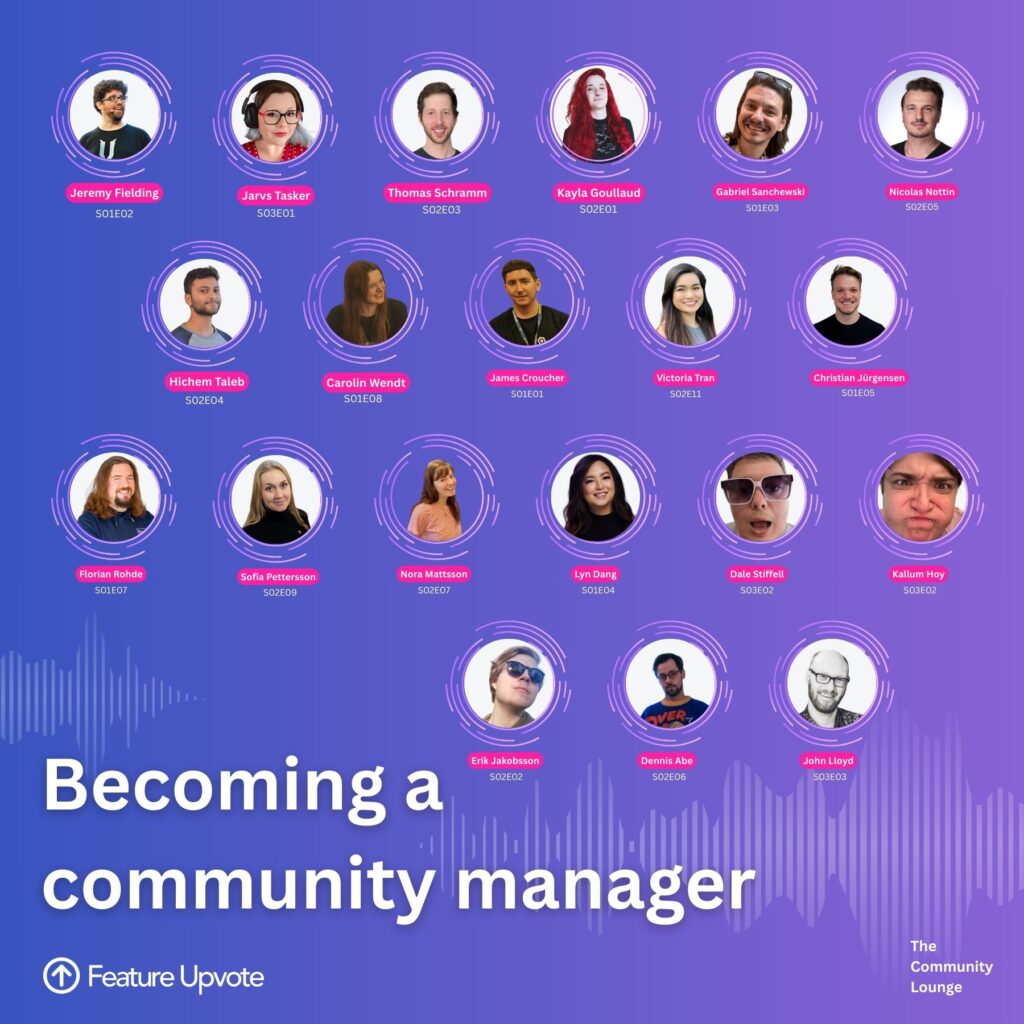
I’ve spent 20+ podcast episodes interviewing community managers about their careers. And I’ve heard all the possible paths to become a community manager: winding detours, lucky breaks, and years of unpaid work that eventually paid off.
The paths cluster into four categories:
- Volunteering your way in
- Leveraging skills from other industries
- Studying your way there
- And building communities before anyone asked you to
Volunteering: The unpaid apprenticeship
Most community managers I’ve talked to did the job for free before anyone paid them. Before they thought of becoming community managers. They just couldn’t help themselves.
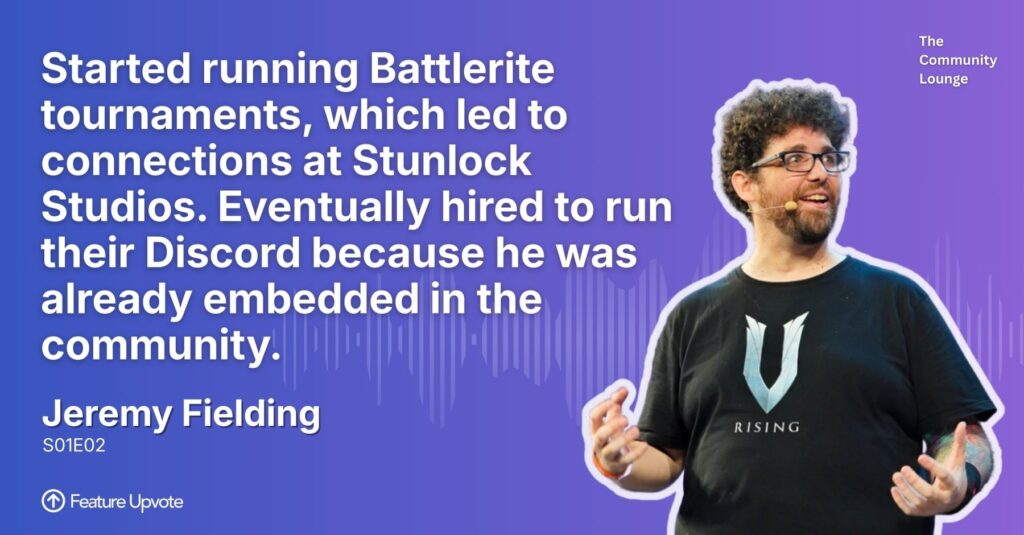
Jeremy Fielding’s story (S01E02) captures this perfectly. He was obsessed with a game called Battlerite, a spiritual successor to something he’d loved years earlier. So he did what obsessed people do: he got involved.
”In 2016, I started running tournaments for this game called Battlerite […] I got really involved in the community. I was a moderator in every Twitch stream for people who were streaming that game and they were kind of like my people for a little while.”
All that free work meant he interacted with a lot of people in the industry, and it didn’t go unnoticed.
”My experience with that led to me getting to know some people at Stunlock because it was a Stunlock Studios game, and eventually they needed someone to run their Discord.”
The job offer came because he was already doing the work. The studio noticed him because he was impossible to miss.
When the studio stopped active production on Battlerite, Jeremy got laid off. But the taste of community work stuck with him.
Some time later, Stunlock’s marketing director reached out about their next game. Jeremy’s volunteer history had made him memorable.
That’s the volunteer path distilled. You show up because you care. People remember. And eventually someone writes you a check.
Other volunteer stories worth hearing:
- Jarvs Tasker (S03E01) spent a full year volunteering as community manager for PlayStation Access’s fan Discord. “I basically was a full-time community manager for free for a year, just volunteering to get that going.” That reference got her first paid job interview.
- Thomas Schramm (S02E03) started moderating Halo forums at 13. “I joined my first English community about Halo 1. I had to learn English and very slowly built my way up.” Then he moderated Destiny’s forums which led him to stop studying for a biology degree and study to become a community manager.
- Kayla Goullaud (S02E01) traces her entire career to a single helpful player in EverQuest. A stranger named Winter White taught her the basics of the game when she was 13. This event led her to become a community volunteer and eventually become a community manager.
- Gabriel Sanchewski (S01E03) created an academy to teach new players how to play a game. Not for money. Because he noticed new players were getting stomped and leaving. The community manager noticed his work, invited him to help at PAX East, and afterwards contracted him for part-time community management.
Transferrable skills: The career pivot
Some community managers walked in through side doors. They had skills that mapped onto community work, even if the connection wasn’t obvious at first.
Customer support: The direct line
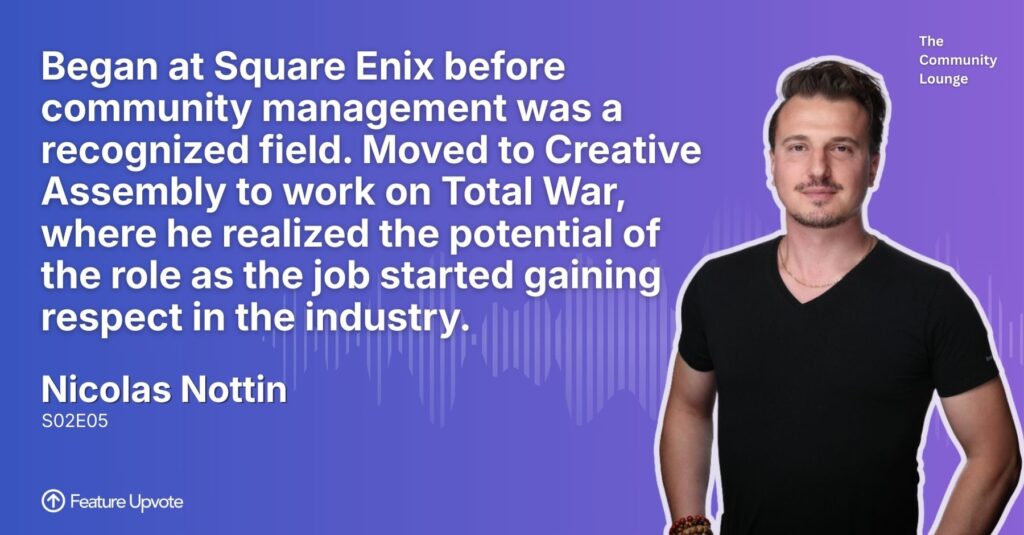
Nicolas Nottin (S02E05) started at Square Enix, but not in community management. “Community management wasn’t really a thing,” he explained. “Community moderation was quite something already, but we didn’t have Facebook and social networks.”
He worked customer support. Answered tickets. Talked to players one-on-one.
“And then it started becoming something and I joined Creative Assembly and started working on the Total War series. That’s when I realized there was a lot of potential there, and the job of community manager started being respected a little bit better in the industry as well.”
Customer support taught him what players actually needed. Not what they said they wanted in forum posts. What they typed into support tickets when something broke. That ground-level view of player frustration became his foundation.
Another customer support story:
- Hichem Taleb (S02E04) was in customer support at Ubisoft and Asobo but really was doing community management. “I learned to manage a community, manage player expectations, but also to give a hand to players one-on-one.”
Social media and communications: The adjacent skill
Carolin Wendt’s path (S01E08) started with pure luck and a willingness to email strangers.
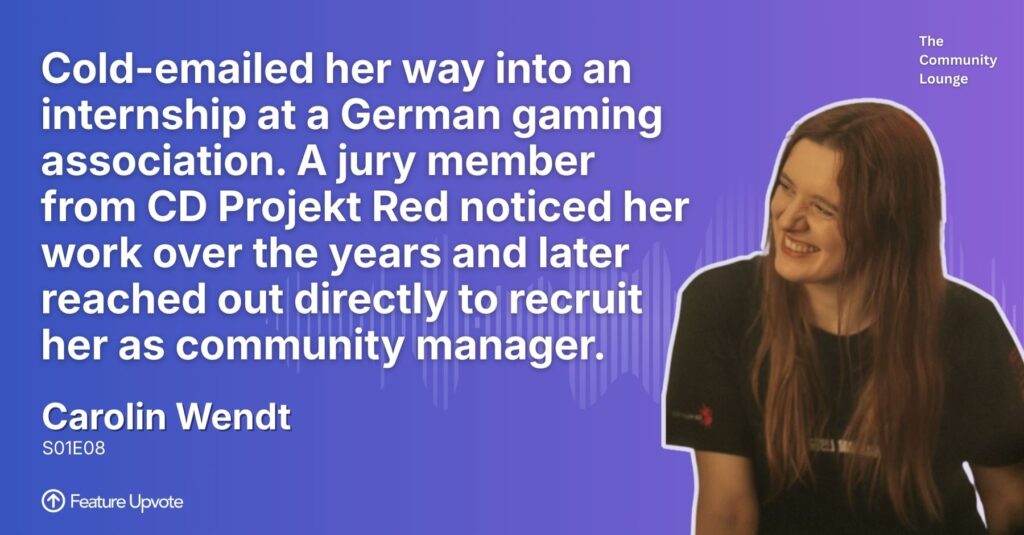
She was studying political science in New Zealand, needed an internship, and decided she wanted games instead of politics. She looked at politics-related game companies like associations to increase the odds of landing a job. “I emailed them cold and said, hey, I want to work. Do you have an internship?”
One organization was looking for an intern for the German Video Game Award. They took her.
“I was lucky that one of the jury members for the award was the current head of comms for Germany, Austria, Switzerland at CD Projekt Red,” she told me. This contact noticed her work over the years.
When she started looking for a change, “he actually reached out to me and said, hey, we are looking for a community manager. How about it?”
She’d built a reputation without realizing it. The newsletter she started, the Twitter presence she maintained, the communication skills she honed. Someone was watching.
Other comms-adjacent paths:
- James Croucher (S01E01) fell into it by accident. His boss said “our social media manager is going to be out for the next two weeks. You’re young, can you do the Facebook?” He tried new things, got praised, and never left community work.
- Victoria Tran (S02E11) started doing side jobs during university. “A lot of startup companies were like, you’re young, you know how to work social media, right? And I was like, sure, of course I do.”
The unexpected transferrable skills
Some paths make no logical sense until you hear them explained.
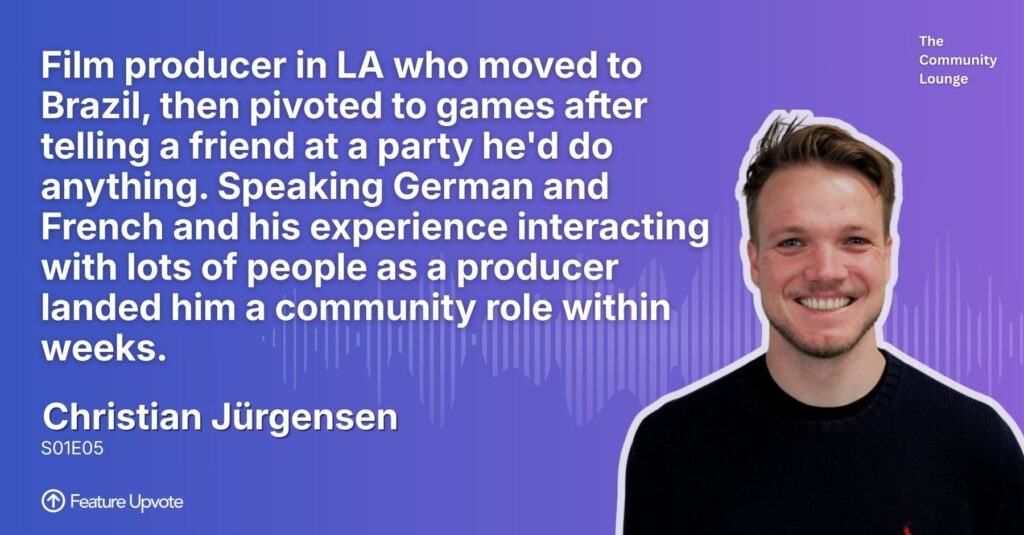
Christian Jürgensen (S01E05) was a film producer in Los Angeles. He moved to Brazil for a documentary project, fell in love with the country, and needed a new career.
“I literally can do anything you need me to do, I’ll do it,” he told a friend at a party who worked in games. The friend asked if he spoke German and French. He did.
“Not even two or three weeks later I started working there.”
His film background gave him something unexpected: people skills forged under pressure. “As a producer you’re have a lot of different stakeholders you’re talking to, from the different actors to the different crew members to location owners.”
Managing those relationships transferred directly to managing communities and internal teams.
Another unexpected pivot:
- Florian Rohde (S01E07) worked at GameStop selling games before moving into community management. His tabletop RPG hobby taught him community dynamics. He just applied one day and got in.
- Sofia Pettersson (S02E09) studied language at university and worked as an alumni coordinator before entering games. The community manager role overlapped with her alumni coordinator experience: “My skill set from being an alumni coordinator at the university overlaps a bit”
Studied: The formal route
A handful of community managers actually studied their way into this career. They’re the exception, not the rule.
- Nora Mattsson (S02E07) studied digital games and community management which “gave me tools and a better understanding of marketing and community management”
- Thomas Schramm (S02E03) switched from studying biology to applied cognitive and media science. Which led to his first professional role at Kolibri Games.
But the most interesting story is from Lyn.
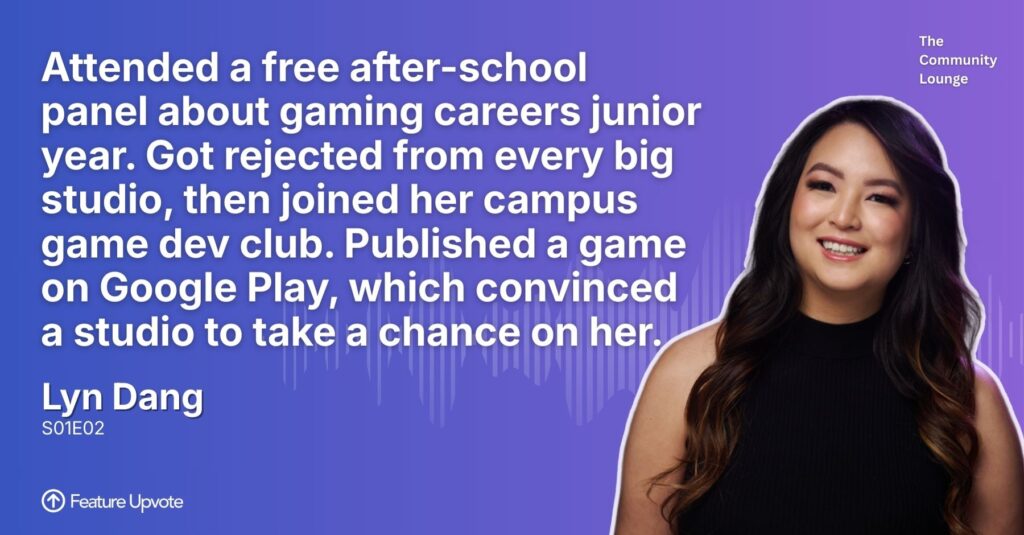
Lyn Dang (S01E04) wasn’t planning on community management. She was drifting through a business degree, unsure what came next. Then she attended a free after-school panel about careers in gaming.
“When I attended that, just out of the whim, and then I realized that this is the connection. The gears churning in my brain were like, I love video games. I could have a career possibly in this.”
That spark hit junior year. She immediately applied to Riot, Blizzard, the big names. Got rejected from all of them.
“That was a wake up call because I realized nothing in my background made me stand out.”
So she found the video game development club on campus. Joined it. She was the only business major in a room full of programmers and engineers. But she threw herself in anyway: organizing events, joining game jams, publishing a game on the Google Play Store.
When she applied for her first community management role, they took a chance on her. Normally they didn’t hire college students. But her club experience, her published game, her willingness to show up and figure it out, that changed the equation.
“They were like, we’re going to take a chance on you.”
Community creator: Build it and they will come
Some people don’t wait to be hired. They build communities around their own interests, and the career follows.
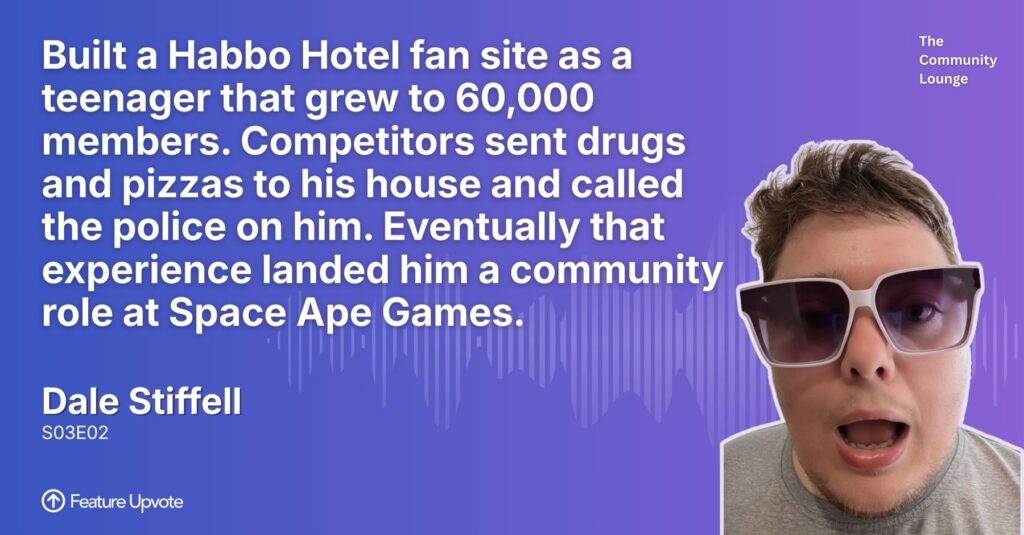
Dale Stiffell and Kallum Hoy (S03E02) now work together at Yodo1 Games. Dale’s story starts as a teenager with a game called Habbo Hotel.
“I made a site and this website grew to like 60,000 members across 10 years and it had like over 3 million people posting.”
Running that site wasn’t easy. Competitors tried to shut him down by sending drugs and pizzas to his house. They found his home phone number. Eventually the police showed up and confiscated his computer.
“I just thought about it and like, nothing’s on my PC. I’m absolutely fine. I’m safe. I haven’t done anything dodgy or illegal. So when I get my PC back, I’m just going to give it another go.”
He kept the site running for another six years after that incident.
“I look back at it and go, wow, that really did shape me in a way where I had to grow up quickly, I had to understand coding to the point where I’m building things in my current role because I’ve done it.”
When COVID hit and he was configuring thousands of PCs for remote work, he saw a job posting for a Discord Community Manager at Space Ape Games.
“I didn’t think I’d get the job. I mean, why would they employ me?”
He went into the interview guns blazing, criticizing their current approach. They hired him.
Other community-building paths:
- Erik Jakobsson (S02E02) started a Discord server for Hearts of Iron IV with friends. “Long story short, that server grew to about 30,000 people.” Paradox Interactive eventually approached him about acquiring the Discord and offered him a freelance position.
- Dennis Abe (S02E06) studied game design in Tokyo but couldn’t find work. He kept building communities around games he cared about. The skills stacked until someone noticed.
- John Lloyd (S03E03) built communities in Age of Empires II, RuneScape, and Guild Wars 2 for years before going professional. He applied for customer support at Ubisoft, didn’t get it, but they saw something else: “We actually think you’re going to be better for doing community management.”
The common thread
Every path looks different. But they share something: most of these people were doing community work before the title existed for them.
They moderated forums nobody asked them to moderate. They ran tournaments nobody paid them to run. They helped strangers in games because strangers once helped them.
But here’s what separates the people who actually made it from the ones who didn’t: they weren’t doing it to build a resume.
The resume-padding trap
Having “Discord Moderator” on your resume five times doesn’t impress the people that matter. What it signals is that you’re treating volunteer moderation like a checklist item. Experienced community managers can spot these people instantly. And we don’t hire them.
Jeremy Fielding didn’t moderate “gaming Discords.” He was obsessed with Battlerite specifically. Jarvs Tasker spent a full year on one fan Discord. Thomas Schramm moderated Halo forums for years before touching anything else.
The depth matters more than the breadth. One community where you truly made a difference will always beat five where you were just present.
What actually impresses
Game studios and publishers are looking for people who can make good decisions under pressure. People who understand nuance.
You don’t learn those skills by being a moderator. You learn them by caring so much about a community that you have to figure out the hard problems.
When you’re genuinely invested, you develop instincts. You notice patterns. You understand your specific community’s culture in a way that can’t be taught in a training document.
Investing in something that matters to you is the best path
So if you want to break into community management, here’s the real advice: find a community you actually care about and invest in it deeply.
It might be a game you’ve played for years. It might be a creative tool you use every day. It might be a hobby you’re obsessed with.
Make yourself impossible to ignore, not by applying everywhere, but by doing something meaningful in one place.
While following this advice doesn’t guarantee the job will find you eventually, it significantly increases the chance. But only if you’re doing work worth noticing.
Thanks to Jeremy Fielding for giving feedback on a draft of this article.