
The Community Lounge » Burnout: How community manager veterans are dealing with it
Burnout: How community manager veterans are dealing with it
Burnout in community management isn’t theoretical.
It’s the 3am Discord notification you can’t ignore. It’s the death threat over a balance patch. It’s the slow erosion of loving your job into dreading your inbox.
I’ve interviewed dozens of community managers for The Community Lounge podcast. Here’s what they’ve actually said about burning out, fighting it, and coming back from it.
What burnout looks like
Workload spiral
Sometimes burnout is simply due to the workload.
“There have been weeks where I’m working like 70 hours.” – Jeremy Fielding (S01E02)
The constant availability becomes normalized.
“I kept responding to players on weekends and evenings… I don’t even know if it was a company expectation or if it was an expectation set by myself.” – Dennis Abe (S02E06)
Identity collapse
Then there’s the identity collapse. When you’re the face of a game, losing that role feels like losing yourself.
“Losing my job basically felt like I lost a part of who I am because I was representing the company so intensively that when I lost that, it felt like I lost a part of me.” – Dennis again
Quiet erosion
The erosion happens gradually. You might not notice the early signs because they’re quiet, internal shifts. Maybe you find yourself less excited about community ideas that would have energized you six months ago. Maybe learning new approaches feels exhausting instead of interesting.
“If you feel you can’t learn anymore… you might be burnt out.” – Erik Jakobsson (S02E02)
Physical symptoms
Your body often knows before your conscious mind catches up. You tell yourself you’re fine. You’re handling it. But your sleep quality tells a different story.
“Consciously I feel okay, subconsciously you are not because you’re not sleeping as well.” – John Lloyd (S03E03)
Imposter syndrome
And when players notice your absence, the imposter syndrome compounds.
“Players are saying, ‘Well, you’re not on’ and it’s 8 PM and you’ve just worked a full day. And then you’re like, ‘Wow, am I really doing a bad job?’” – Dale Stiffell (S03E02)
Dread
Then there’s the dreading.
“There have been a lot of situations where I’ve been like, oh God, I don’t want to like open up my email today because it’s going to be a problem.” – Victoria Tran (S02E11)
That dread is a warning sign most community managers recognize too late. It’s not about one bad day or one difficult week. It’s when the dread becomes your default state. When you wake up and the first emotion attached to work is anxiety, not excitement or even neutral acceptance.
Pushing it down
We convince ourselves we can push through it. That acknowledging burnout somehow means we’re not cut out for this work. That we should be stronger, more resilient, better at compartmentalizing.
“Burnout is something that you can always avoid, but it can be hard to identify because we’re dealing with so much constantly. When that burnout is starting to show its head, we do push it back down because we think we’re better than that. Please for anybody listening, if you do experience burnout, reach out.” – Kallum Hoy (S03E02)
Why community managers burn out
The lightning rod effect
The job is structurally exhausting. You’re the buffer between an entire player base and a development team. You absorb anger that isn’t meant for you personally but hits you personally anyway.
“You’re like the lightning rod… It’s a lot of energy and it’s not directed at you, but you’re handling it.” – Lyn Dang (S01E04)
Being a lightning rod isn’t a metaphor. It’s an accurate description of the role. Thousands of people channel their frustrations through you.
Even when they’re not attacking you specifically, you’re the one reading it, processing it, deciding what to escalate and what to absorb.
That takes a toll that’s hard to explain to people outside the industry.
“There is a lot of pressure on community developers and managers to protect developers quite often from some of the toxicity, some of the really mean stuff that is happening on forums and social.” – Nicolas Nottin (S02E05)
The job never stops
Players don’t sleep, at least not all at once.
“The gamers don’t sleep. Well, they do, but then there’s other people in another time zone who are awake and now they’re angry at you.” – Victoria Tran (S02E11)
Marketing pressure
Marketing timelines add another layer of pressure. Games operate on launch schedules, announcement windows, and coordinated reveals across multiple platforms and regions. When something needs to go live, it needs to go live now. Not Monday. Not after the weekend. Now.
“Things need to happen at that moment… sometimes you have to work crazy hours.” – Jeremy Fielding (S01E02)
Death threats and toxicity
For some, the darkness goes deeper. You even receive death threats over balance changes.
“It is just coming from a place where they’re so angry. Where they feel like it is the right thing to do.” – John Lloyd (S03E03)
The threats were rarely credible for John, but that didn’t matter to his nervous system. Your brain doesn’t distinguish between a real threat and an internet threat as clearly as you’d like. The anxiety response triggers either way.
When personal problems compound
Sometimes your problems compound. Personal life doesn’t pause because work is hard.
“There was one year where there was a few issues personally that I was dealing with and it was that time of the year again, where it was pride and people were just being so incredibly toxic and hostile where I just couldn’t deal with it.” – Kallum Hoy (S03E02)
“It’s always when you have your own personal stuff that you’re working through that everything else piles on.” – Victoria Tran (S02E11)
This timing isn’t coincidence. When you’re already running on empty, every additional problem hits harder. Your capacity for handling stress isn’t unlimited.
Indie studio grind
In indie studios, it can be even worse as the budgets are tiny despite all the work.
“10-12 hours a day moderating.” – Thomas Schramm (S02E03)
“The first marketing budget is your salary.” – Hichem Taleb (S02E04)
In larger studios, you might have a team to share the load. In indie studios, you’re often the entire community, marketing, and support team rolled into one person.
Emotional attachment
And the emotional attachment makes leaving harder.
“When you are a community manager, you can get very attached to the communities. And when you do move on to a different game or a different studio, it can be quite difficult.” – Jarvs Tasker (S03E01)
How to deal with burnout
Physically disconnect
When you’re already in it, the first move is usually physical. Not mental. Not strategic. Physical.
“The best thing that you can ever do for yourself is just take time away. And that is turning off Discord or logging out and not being available.” – Kallum Hoy (S03E02)
Not checking occasionally. Actually turning off. Logging out so you have to intentionally log back in. Turning off notifications so your phone isn’t buzzing in your pocket.
Leave your space
Turn off the devices and go out for a walk. Get physically away from your computer.
“I will literally then step away from my computer. Let the team that I’m working with know that I’ve just gone through that… go out of my house and send a message to my friends and say, ‘Hey, can I come round and literally just spend some time with friends?'” – John Lloyd (S03E03)
Talk to someone outside
Sometimes you just need five minutes with someone who isn’t marinating in the same stress.
“Let’s just have a coffee somewhere for five minutes and talk about it.” – Nicolas Nottin (S02E05)
Getting perspective from someone outside the situation helps. They don’t know the drama. They don’t care about the latest controversy. They’ll listen to you vent and then probably say something simple that reminds you this isn’t life or death.
“Talk with someone who actually never reads the forum and being like, how would you react?” – Nico again
Physical exercise
Physical outlets work for some people. Exercise doesn’t solve burnout, but it does give your stress somewhere to go besides your chest and your jaw and your shoulders.
“I try to let loose of potential stress. I go to the gym five times a week… it’s nice.” – Erik Jakobsson (S02E02)
Get professional help
You shouldn’t be afraid of professional help or think it’s a weakness.
“I ended up having to have effectively a week away from work and reaching out to a professional, a therapist… It might just be one session to talk about it, but it can also be several months of counselling to move past it and be fully mentally healthy again.” – John Lloyd (S03E03)
Sometimes you need someone trained to help you untangle what’s happening in your head.
Reframe the negativity
Reframing the negativity can also help build mental endurance.
“They don’t hate you… they just can’t formulate what they want to say.” – Erik Jakobsson (S02E02)
“They care so much… someone who didn’t care would just leave.” – Lyn Dang (S01E04)
Players who are truly done don’t write angry forum posts. They just uninstall. The people screaming at you in all caps are still here. That doesn’t excuse bad behavior, but it does help to remember that passion and frustration often look identical.
Find real distraction
Finding distraction that genuinely takes your mind elsewhere matters. Not scrolling social media or watching gaming content. Something that pulls your attention completely away from the industry.
“For me, it’s just turning off, picking up a book and losing myself in a different world or writing my own.” – Kallum Hoy (S03E02)
Connect with other community managers
Having a safe space with peers who understand helps.
“A room where you can retreat to that is more calm, quiet.” – Gabriel Sanchewski (S01E03), describing The Break Room, his private Discord for community managers
These peer spaces matter because only other community managers truly get it. Your friends outside gaming try to understand, but they don’t know what it’s like to receive 500 angry messages before breakfast. Other community managers do.
How to prevent burnout
Set boundaries
Prevention starts with boundaries.
“The biggest point is setting boundaries and maintaining them. What I mean by that is dividing your life between professional and personal life.” – Dennis Abe (S02E06)
Create physical separation
Physical separation matters too. Make it harder for work to bleed into your personal time by creating friction between the two.
“Set up separate accounts for when you start working. Never use your personal accounts. Try to find ways to separate when you work and when you don’t work, like having two different devices, taking a walk after you stop working.” – Dennis again
This seems simple, but it’s powerful. When your work Discord is on a different device, you can physically leave that device in another room when you’re done.
Protect your privacy
Privacy is also a good way to protect yourself. The less ammunition you give people, the less they can use against you when they’re angry.
“Having very strict boundaries about what I share about myself online is very helpful for my mental health and for what people can quote unquote attack.” – Victoria Tran (S02E11)
Delegate and systematize
Instead of doing everything yourself, delegate or set up rules to make it transparent for the community when you’re active. Players can handle knowing you’re not available 24/7. They can’t handle uncertainty about whether you’re ignoring them.
“You can have moderators helping you out or you can have some sort of rules being set up automatically over the weekend.” – Dennis again
Moderate early and often
Don’t hesitate to moderate too much than not enough. That’s how you keep toxicity low.
“Moderate from the get-go. A toxic environment attracts toxic people.” – Florian Rohde (S01E07)
Work at a supportive company
Company culture matters enormously when it comes to preventing burnout. You can have perfect boundaries and still burn out if your company doesn’t respect them.
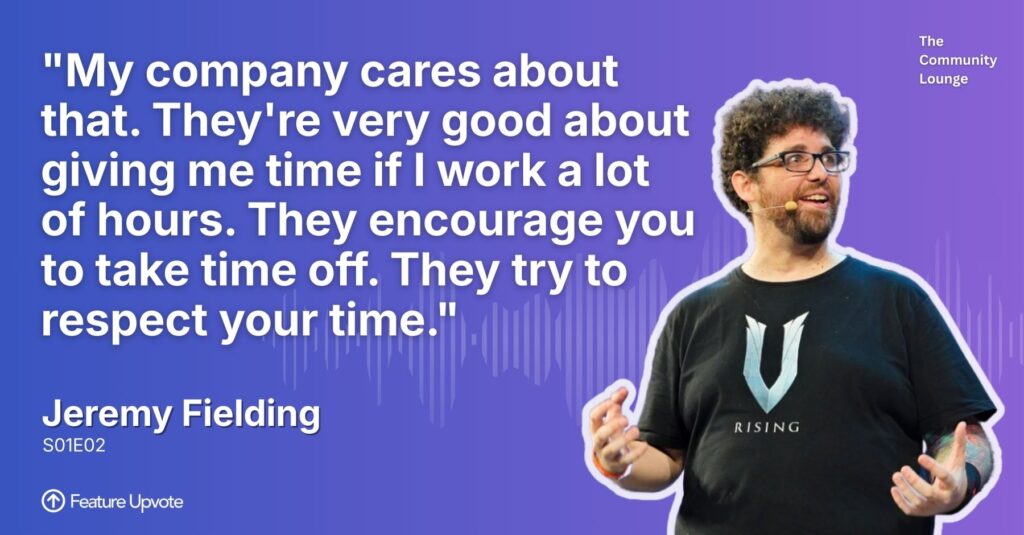
“My company cares about that. They’re very good about giving me time if I work a lot of hours. They encourage you to take time off. They try to respect your time.” – Jeremy Fielding (S01E02)
If you don’t have that support directly, try asking for it.
“When Kallum says ‘I need to take some time’, I’m like, ‘Yeah, man, you know, you need to do you. I’ve got you covered.’ That’s how I want all our community managers to work. If anybody ever needs some time, they should just, in a respectful way, go away and take the time you need.” – Dale Stiffell (S03E02)
Build psychological safety
Psychological safety helps you take risks without fear. When you’re allowed to experiment and occasionally fail, you don’t carry the constant anxiety that one mistake will cost you everything.
“It’s just good that I can feel secure in that, that my bosses and my colleagues give me that space to try things and don’t scold me if it doesn’t become perfect at the first try.” – Sofia Pettersson (S02E09)
Find a mentor
A solution if your boss or company isn’t up to the task is to find a mentor. Someone outside your reporting structure who can give you perspective and advice without the organizational politics getting in the way.
“I meet her once a month and have a coffee and talk just in general about my job. And it’s really, it’s such a good thing to have.” – Sofia again
Keep perspective
Finally some community managers build resilience through perspective. This doesn’t minimize the work or the stress. But it does help keep the scale of things in check.
“Ultimately, it’s just games.” – Christian Jürgensen (S01E05)
Conclusion
Burnout isn’t something you solve once and forget about.
It’s not like beating a boss fight where you learn the pattern, execute perfectly, and never have to deal with it again.
It comes back. Different triggers. Different intensities. Different seasons of your career.
The community managers I’ve talked to aren’t burnout-free. They’re just better at recognizing the warning signs. They’ve built systems that catch them before they fall too far.
Some of them still work 70-hour weeks during launches. Some still dread opening their inbox on Monday mornings. Some still get death threats over balance patches.
But they also know when to log off Discord. They have friends outside gaming they can call. They’ve learned that “I need a break” isn’t weakness, it’s maintenance.
Thanks to Jeremy Fielding for giving feedback on a draft of this article.