
Subscribe to The Community Lounge podcast
(You can also watch this episode on YouTube.)
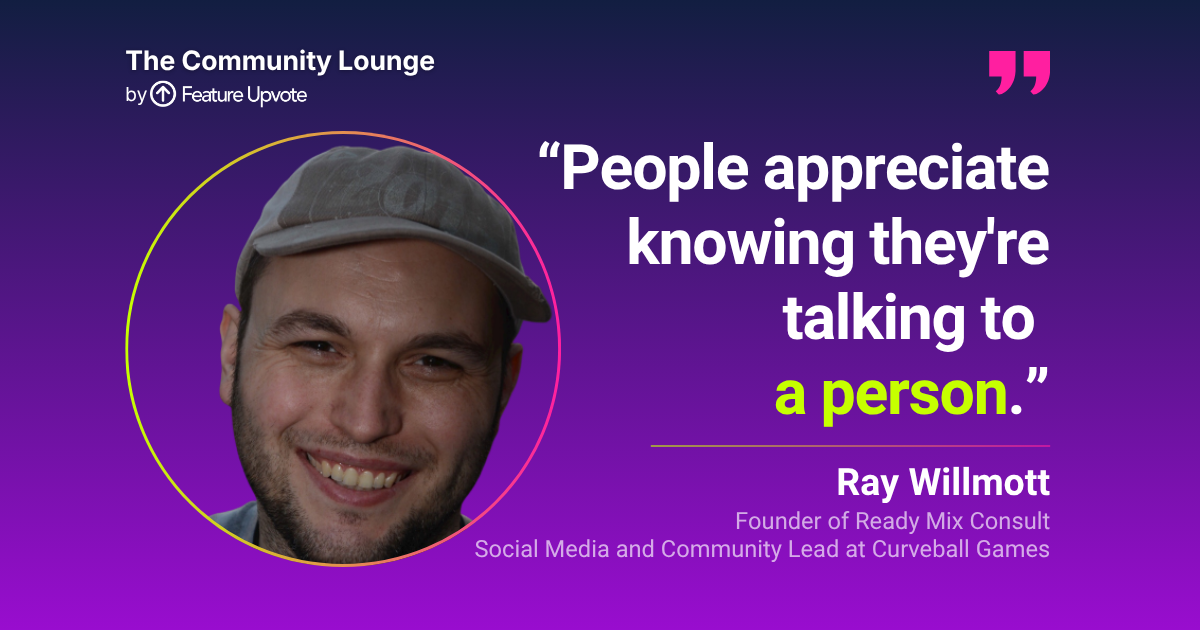
Today’s guest is Ray Willmott, Social Media and Community Lead at Curveball Games and founder of Ready Mix Consult. Ray’s path into games began after a decade working in local government before transitioning into games journalism and eventually community management through volunteer writing and moderation work.
We chat about how skills from public sector work shaped Ray’s approach to community management, why Steam reviews have become increasingly important for a game’s visibility and success, and how community managers can turn negative reviews into positive outcomes through thoughtful engagement. Ray also shares advice for aspiring community managers on avoiding burnout, building experience through volunteer work, and navigating the challenges of today’s games industry.
Games mentioned in this episode:
- Hades II
- Blue Prince
- PRAGMATA
- The Secret of Monkey Island – Special Edition
- Tetris Effect – Connected
- Sente
- Planted
Find Ray on:
The Community Lounge is brought to you by Feature Upvote – Painlessly collect feedback from your players. More insights, less noise.
Subscribe to the Community Lounge newsletter and get notified of new episodes and articles.
Transcription
Steve McLeod
Today I’m joined by Ray Wilmott in Wales. Ray is currently juggling his time between two roles. He is the social media and community manager at Curveball Games, and he’s the founder at Ready Mix Consult, which is a great name. Welcome to the show, Ray.
Ray Willmott
Hey, thanks so much for having me.
Steve McLeod
Ray, why don’t we start at the very beginning? Tell me how you got into community management.
Ray Willmott
Yeah, it’s a great question. So for me, I, so for a long time, I wanted to get into games. So I think that’s been many people’s aspiration who probably watch the show. And, you know, I think that came from a love of like playing games when I was five, you know, and just playing all sorts of systems. I think I started out on like the Commodore and the Amiga like really way, back. Cause I’m old.
Steve McLeod
Wow.
Ray Willmott
And basically I, for a long time, I was working in local government. So it was one of my first jobs I got cause my mother was there. And I managed to get like an administrative role. And so I was working in local government for like 10 years and where I live. it’s basically, it was just a mix of roles.
It was working in like social service, it was working in housing, it was working in education. But like, I think I got to this point where I like, still, the passion for games that obviously never died, because I was still playing games. And I think I always just wanted to see how I could do it. Cause I was seeing like journalists like doing these incredible articles and I was seeing all the amazing work that people were writing for games.
And eventually I just was like, started looking at just some like websites, who were looking for volunteer work and I just put my name forward. I was very lucky to get accepted to do a review for a couple of games. And that’s just basically how I got my start. Like I basically just started just doing all this, all reviews for games, some news posts occasionally.
Steve McLeod
This was paid paid work?
Ray Willmott
This was volunteer. This is volunteer to begin with. I think, and I kind of needed that experience anyway, because I, I didn’t feel like my… I was writing in a way that made sense or worked for magazines or for outlets, but gradually over time that then turned into paid work. Yes.
I actually set my own website up briefly for a while, worked with some people there, started going to more events. And that eventually led me into getting to the point about community management. So I had a hybrid role at Pocket Gamer, which basically allowed me to do news posts. allowed me to do, I was actually looking after a community called the App Army, who’s some may be aware of.
They basically, you know, it was like finding a new mobile game for them to play every week, right. So whatever was kind of new on the app store, we would just find that game with the publisher and then get some codes for them to play it. And then they would do like a snippet, an article on that. And that also then extended to me becoming a community manager because I was helping on social media, I was promoting articles that on the site. And so it was kind of a nice halfway house to get me into, you know, into the social community side of things, but then also maintaining what I was doing for the last however long.
And then from that, then I just started building into other roles. Like I worked at a children’s entertainment company for a while doing their social media. I was actually, I briefly had to leave the games industry for a while. went back to life sciences. I did some social media work there, which was kind of interesting. And, but then I, my biggest main role was working at Perp Games and Coatsink where I was doing the social media for them for a long time and community management of building like Discords and such.
And then in more recent years I’ve been working in brands. So, interesting, probably an interesting segue, but, a lot of the work that I was doing in community and social actually helped train me to become a brand manager because, you know, I feel like there was like by extension in the smaller teams, didn’t have de facto dedicated brand product managers, but you know, from like the work that I was doing, like building plans and materials and such, and tone of voice, those are natural like linking points to becoming a brand manager.
Steve McLeod
There’s so much there, there’s so much you’ve told us.
Ray Willmott
Lots of unpacking. Hahaha.
Steve McLeod
But yeah, a couple of things. First, people in community management roles often worry like, what can I do next if this doesn’t work out? And you make a really good point that there is a natural path there into brand type work because you are the brand often in a small team as a community manager. You are the brand, at least as it’s represented externally.
And the other thing really interesting, you know, before I started recording these podcasts episodes, I would have guessed that community managers almost one hundred percent start young. Like it was they go they do it when they’re eighteen or the twenty or something. And I find about half and half of the guests, about half started young and about half had another career first like yourself. And they come in such a diverse world. So that’s really interesting. Hey, do you miss the local government work?
Ray Willmott
Yeah, I mean, just to touch on your point there, yeah, I mean, it’s a great point. I started, my real start was at 30, right? So I mean, I’d had a good, you know, 10 to 15, 10 year career prior to getting into games. You know, it’s not a, and I sometimes get sad about that, because I think like, if only I’d been able to start 10 years earlier, where would I be today? You know, but it’s, you know, it’s hindsight and such.
Yes and no, think there’s obviously, you know, well as I do, the games industry is a little bit in flux at the moment, you know, between, you know, redundancies, layoffs, you know, there’s a very volatile nature around things, which is obviously really, really awful to see. And I think the difference there with local government, particularly, is that there is more security generally. They’ve obviously had, they’ve had redundancies, absolutely. I’ve seen waves of redundancies there and I’ve seen people have to take pay cuts.
Steve McLeod
Yeah.
Ray Willmott
There’s been strike action. So I mean, there’s been a lot of that as well when I’ve been working there. But I think in general, like when you have your dedicated pension system, you have your dedicated annual leave. You know, I mean, not that I would recommend it, but I used to know of people who were on long term sick leave for as long as six months, you know, and that was all paid, right? I mean, whereas if you’re talking in games now, it’s adjustment. Sometimes you’re lucky if you get more than two weeks.
So, you know, just, just benefits like that, you know, I mean, that’s security to know that you can be ill, you can take the time you need to recover and, know, you can, you’re not going to be kind of just axed on all the of the side. So I think there, there are things like that, which I think are missing, and I do think about, and just the variety of work was pretty good. Like I said, you know, I had some incredible stories. I worked in social services for a long time as a minute taker and I would go to people’s houses, I would be literally sat there listening to conversations about, you know, the difficulties of their family lives and the hardships that they go through.
And it was just so interesting and sad as well to hear these stories of how people started their life in such a difficult way and how privileged I was to sit where I sit, you know. So it really adds a weight in the perspective to things sometimes when you know you are like, we’re working in games and it’s a massive privilege to do so, but you know, it’s not life and death, you know.
Steve McLeod
Yeah, yeah. And how has that local government work prepared you for your work in community and social?
Ray Willmott
I think, yeah, it’s the working on the variety of things as mentioned. I mean, obviously having worked in different sectors, everyone has different challenges, different expectations. And I think working, because of that working with people, know, working with the public generally, I think that massively helps me in terms of, you know, I’ve always been able to talk to people openly, always been able to be friendly and communicative.
You know, and I feel, and I think that’s quite an important skill to have as a community manager because you are basically, you know, talking about, you know, you are talking to people on a daily basis, right? From all over the world, you almost have to always be on in that sense. So, I mean, that part of it definitely, but I think also just the, you know.
Because in local government, also have to be careful what you say. You have to be careful what you do. You can’t, you are generally, there are certain things you cannot talk about because, you know, you can’t disclose the nature of the business. So I think that that is a huge part of it as well, because, you know, we will have access to incredibly confidential information that, know, that is, that is, know, contractually obligated or, you know, it may, there may be, you know, elements to it that you can’t say certain things, reveal certain things because, you know, you’ve, you know, you’re bound to it.
So, I think getting used to that style and mindset and way of thinking really does help you to prepare you for these sorts of things because you are on the spot like all the time 24/7 and you know, there are chances for slip ups because of course there are but you know, like you just trying to get back on track and find ways to work around it.
Steve McLeod
Yeah, yeah, that’s actually a strong similarity between the two jobs. So I hadn’t thought of that. We didn’t touch on the two roles. Tell us about why you have two roles, how they work together, what they are.
Ray Willmott
Yeah, sure thing. I mean, to be honest, predominantly at the moment, I am working with Curveball Games. So I recently joined the team there as their social community lead, very small team, very, very small publisher started like really sort of gained momentum last year. And so as a result of that, we’re a very small team of working similar structure that I’ve had previously at like Coatsink and Perp Games where, you know, we’ve kind of all mucked in together to build the wider, you know, remit and working around the products we have. That is my full-time day-to-day job. That’s what I do.
But on the side, know I do also have so I’ve been working on a YouTube channel, which I’ve built which is Ready Mix Gaming, which is an extension of Ready Mix Consult. You know, I’ve been doing some freelance work for other companies as well. So I’ve mentioned I’ve previously worked with for Raw Fury, Wales Interactive places like that. But then I’ve also been doing some bit jobs where I can support other people. So they might say, hey, can you maybe advise me on this thing? Or can you can you help me with this or help prepare a plan for this? You know, beat that I’ve got coming up.
So, occasionally or even there might be some community support even which is quite interesting because sometimes they’re like, actually I need an extra pair of hands to help me in the Discord this weekend Can you help me out? Sure thing, you know, so I think that that’s kind of where the freelance side of things is working at the moment It’s usually in my own free and spare time.
So it’s outside of the typical 9-to-5 And you know, it’s just about kind of like making sure that I’m keeping a work-life balance kinda thing is always the tricky thing with these things is that you have to try and know find time for yourself to go out for a meal, to go to the pub to do quiz, you know, to walk the dog, you know, so it’s just, just finding time for yourself as well, which is, I think it’s the tricky bit.
Steve McLeod
Yeah. Yeah, it’s I think it’s really wise actually to do the extra consulting work because it also keeps you very well connected, well networked. You never know when in this industry, you never know when you’re gonna need that network to depend upon. It also keeps you exposed to new ideas and so on.
Ray Willmott
I think that that is probably the big reason why I set up the consultant. So I set it up in officially like in December, because that’s when I started properly getting contracts. And I have unfortunately been part of recent redundancies and I have unfortunately lost my job.
Steve McLeod
Yeah. Who hasn’t?
Ray Willmott
Who hasn’t at this point, right? Which is a sad indictment of the industry, unfortunately, but I feel like it’s a relatable story, unfortunately. But I think that allowed me to maybe to think, okay, well,
You know, I don’t want to put myself in this difficult situation again, where, I don’t know where I’m going to be in a couple of years time. So if I have something I can own and maintain myself and I can, I can work with people and like you say able to network, keep, talking to people. Then hopefully, you know, I won’t need to be worrying about these things in a few years time.
So it’s just the way I guess I described it, betting on myself a little bit, which I think more people should do, and they should really feel confident. You know, once you build up a base of skills. Once you’ve had time to refine those, think it’s important to just like say, actually, do you know what? I do know my job. I do know what I’m doing and I can hopefully help other people when they need it.
Steve McLeod
There’s some people I’ve met via this podcast, a couple of people who stand out in my mind who have done that so well that I think they’re kind of it’s almost impossible for them to be unemployed for an extended period of time. They’ve done such a good job that if they were to say on LinkedIn today looking for a position, they would have five people reach out to them. And, you know, that doesn’t come easy. To get in that situation, you really do have to bet on yourself and do what you’re saying.
Ray Willmott
Hahaha. Yeah, absolutely.
Steve McLeod
So there’s a couple of topics I wanted to talk to you about. you let me know in advance that these were topics you had some experience in. One is about the benefits of community management for Steam reviews. Now everybody wants great Steam reviews. So this one I thought I needed to get you to tell me about. Tell me more about this. How does community management help Steam reviews?
Ray Willmott
Mmm. Yeah, so I think what we’re seeing more recently is that Steam reviews are just growing in relevance all the time. So even more so, and obviously I, as an ex-journalist myself, and I say this with all the respect and love in the world, this is even in spite of, you know, press and critic reviews. Like I think those are massively important. They have their place, but what we’re seeing at the moment is it’s almost a bit like the Rotten Tomato situation I liken it to, right? So you have the audience going, have the critics score.
So the critic score is usually somewhere down here and then the audience score can be right up there. So I feel like that’s sort of what’s happening at the moment in the games industry is we’re having, you know, a very similar disparity where people are disagreeing with the critics and they have their own opinions on things. And so you can have these wildly different views, right? And so I think because of that and because those community rules actually in many ways, because we’re so centered on Steam for a lot of the products that we do, and this is talking specifically more about Steam, suppose.
It affects the algorithm, right? So, you know, you have, if your game is in overwhelmingly positive, you immediately are gonna be more favourable to Steam. They’re gonna promote your game more. They’re gonna talk more about it. You’re gonna get the top billing. They’re gonna offer new opportunities and deals and offers to you, daily deals, things like that. So it immediately opens the floodgates to potential, and so maintaining that is so important for your game because equally, if you’re staying in overwhelmingly positive, you’re gonna be more attractive to people as well, right?
Because they’re gonna see, this game has been reviewed so well by 5,000 people. Clearly this must be worth my time and energy. And if it’s in a sale, I’m going to grab it. so I think maintaining that’s very important. Now there is ways of doing this, of course.
Steve McLeod
That’s what people want to know, what are the ways?
Ray Willmott
So obviously when we’re talking about positive reviews, are they always worth responding to? Depends. I think, you know, when you’re in a situation where someone has just been very nice and polite about it, you could reply to that and say that we really appreciate, thank you for your support. And that’s a lovely gesture to have.
But I think what people are tending to do is focus more on the negative reviews, where, for instance, if you have, “oh, this game broke because of X glitch, and I don’t get past it, and I’ve refunded it because I’m in my two hour window.” So you get that sort of dialogue. And where I think we’re seeing a change there is the community manager or maybe the developer. It could be either or, depending on the structure of your team.
They’re going into the review. They’re replying to that saying hey, I just released a patch that affect directly repairs this exact issue that you’re having. Obviously no obligations, but maybe you know, maybe take the time to check it out again if you feel so inclined. We’d love to get your feedback. We’d love to maintain your support and I think it’s the presentation of how you respond to people and it’s about the battles you pick or suppose or the comments you choose.
I think it’s, you know, obviously I would never suggest to someone if you have say 10,000 reviews, don’t try and reply to every single one because you’re going to be there all day. As lovely as it would be to actually have that one-to-one connection with people. And I’m an advocate for that, you know, being able to talk to people once one and learn about their experiences. I think that’s lovely. But I think, you know, just being very selective and mindful about the ones you’re picking out. And also when you are responding to one of those negative reviews about the patches and things like that.
Steve McLeod
Mm-hmm.
Ray Willmott
Make sure that if it’s an issue that’s fixable or something you know has been fixed, those are the ones probably to target rather than something obscure that only happened to this one person. And you probably will never be able to replicate that in the game because that’s almost certainly going to set you up for failure. But if you are producing a proven, I guess, build-up of responding to negative reviews with positive sentiment, you might actually be able to flip that review.
And that, that I think is the end goal. You want to try and see if you can flip that review or, maybe possibly add to your overall score or metric, which is an effect the algorithm even more. So it’s all kind of parts of the system, I guess.
Steve McLeod
Yeah. I like it. So it’s an example of community managers not just being posting on social media. That’s often the stereotype they get, but actually doing something to improve the chances of the game to be a financial success. And I mean the games need to be a financial success to exist, to continue existing. Great, great. I like Yeah.
Ray Willmott
Yes, exactly. Yeah, and I think that’s an interesting thing because I guess I’ll go on a little bit of a tangent. We did talk about that previously before the call. I think when I first started in social and community, there was definitely an uphill battle to get funding, get budget, get justification to the business. We need this person in place.
“Can’t you just do it? It’s only social media.” It’s all, “Can’t you just do it? It’s just responding to a couple of comments.” It’s not, you know, it’s, that’s not a full-time job, surely. As you and I both know it very much is, and I’m sure everyone listening to this knows it’s a full-time job and then some. But, that’s the mindset I think has shifted from this maybe mentality, maybe 5 to 10 years ago to today, where we’re looking at a very different and almost it’s a crucial member of the team now, because that community manager is now not only, you say, responding to those team reviews.
They’re in the Steam discussions as well. So like, you know, you’ve got like the topics and people are listing different reviews. So like they’re responding to those, trying to get that information. They’re doing Steam VODs to try and get the visibility on the Steam page. So you’ve got the videos you’ve got there. On top of that, they’re often, as we both know, they’re hybrid roles. So they are doing social media. they’re doing all the Twitter, Blue Sky, Threads, wherever it is this week, Instagram, you know, creating TikToks, doing that kind of thing.
And then there’s again, the mindset on top of that, where I think, you know, indie developers these days are often doing daily content on socials to try and beat algorithms there as well, to try and get that visibility and break through that noise. so almost certainly now you’ve gone from a role that was, “Don’t know if we can justify this” to, this is about a team of five, if not six people could be doing this one job and it’s often put on one person’s shoulders. It’s, yeah, it’s a herculean thing.
Steve McLeod
Yeah. I think even worse if you’re doing social media as well as everything else, you’re doing it from a place of tiredness, of exhaustion. And it’s just hard to deal with some of the more negative things you see on social media when and you end up like replying to it in a bad way. and so on. Yeah.
Ray Willmott
Yeah, it happened. It happened. You know, again, we are human, right? And I think this is the again, the mindset of where AI comes into this as well, because, know, like, obviously, there probably are tools with AI, and I’m sure AI will continue to grow in relevance in this space where people are responding to that through AI tools, right? But I think having the human connection is so, so important for these roles. And that, know, that’s something I’ve learned coming from, you know, that local government background and into it.
Is that, you I think people appreciate knowing they’re talking to a person and they appreciate that. Equally, that does come with its challenges. If I’m responding to, if I’m still awake at midnight and responding to someone who’s just woke up in their time zone, I’m probably, I’m going to be a bit tired.
Steve McLeod
Well, that’s actually so that’s obviously an un unhealthy way to work, which is a really good segue into any tips you might have for first time community managers on how to go about their job and how to do it well.
Ray Willmott
Yeah, I mean, I think that that’s probably the first thing I would say immediately is please don’t burn yourself out because these kind of roles really can burn you out and they can be very tiring. They can be very demanding. They can be very exhausting-It’s a lot to take on. And as I just sort of highlighted before this, there’s a lot of responsibilities. Now there’s a lot of different rungs of this ladder. So we’re not just talking about manning a couple of social channels. Now we’ve got a full elaborate system, you know,
Like we’re sometimes you’ve got community manager running play tests. Sometimes you’ve got them, there’s all sort of strings to this now. So I think it’s worth looking at, because I think what’s probably gonna happen, well, I hope this is what happens, is that we start having more dedicated individuals to these resources rather than this is all one person’s job. So hopefully we get to that mindset of this is growing and building outward. So all I would say is look at the different ways you can be a community.
You know how you can support communities. So maybe do look at specific channels, maybe look at how they however this subreddit is managed or however Discords are built or you know and looking specifically about what people are doing right and wrongly they’re making some notes yourself like, you know, I would probably do this differently or actually this is really really good.
I’m gonna make a note of this for you know myself I think that’s always a good thing to do and being active in those forms as well because a lot of people that I’ve met over the years have probably started their role either similar to me kind of doing the volunteer route getting into by journalism or even doing it by being a volunteer part of a Discord or volunteer part of a forum or a subreddit and they’ve actually been a very instrumental part of and I think you’ve had people, guests on your, on here who have had similar routes as well. It’s like just using that experience and building that experience and learning how to do the job by proxy.
And then eventually start thinking, yeah, do you know what, maybe I do feel confident applying for this. And I’ve got some, a body of work which I can link people to and share. And this is what I’ve done. And I’ve been a recommend, you know, a very appreciated mod in this forum or a very appreciated spokesperson in that forum. So I guess that’s how I would look at it for now, but it’s always difficult, I think, because these roles are very, they’re both far and few between at the moment, unfortunately, because of where we are. And also it’s the case of they are very competitive.
Steve McLeod
Yeah. There’s a episode that we’ve recorded already, but it’s not yet published. It will be published by the time this episode is published. With Joshua, who at fourteen was already a moderator on a subreddit for a really well known brand. It’s just amazing when you talk about the people getting involved in Reddit really young. It’s incredible. The stuff you can do, and I guess nobody ever asked him his age because you know, you’re you’re just the name on screen.
Ray Willmott
Yeah, exactly. are, you you’re not, you really go by your own name. You probably have some kind of, I don’t know, like Fox McCloud 7.
Steve McLeod
And I think you shouldn’t, you’re right. You probably shouldn’t go by your own name.
Ray Willmott
Yeah, precisely. Yeah, precisely. You want to make sure you protect yourself.
Steve McLeod
You said the advice you’d give for a first time community manager is to not get burnt out. But can we do you have any more specific tips for how not to get burnt out?
Ray Willmott
How not to get burned out. I think you need to be disciplined with yourself. And I know that’s extremely difficult when you’re starting out because you’re gonna want to be eager to impress. And I have done it myself. So this almost feels hypocritical me even saying this, but I’m learning from my own mistakes and saying like, just be very, very careful about what you take on, what you accept, what you agree to and just try to just be, you know, don’t try to do everything all at once.
Steve McLeod
Mm-hmm. I see.
Ray Willmott
Take your time, build up, build up very, very slowly. And by, and maybe by doing so is like setting yourself, maybe create a Trello board, maybe just create, right. These are the things that I need to do. These are the, these are the nice to haves. And these are the, I’ll get to in 6 months, 12 months time, right? And so you’ve kind of organizing your time a little bit there, but I mean.
Just also be very transparent with your goals like with your leader or your boss or whoever it might be or your line manager and say right okay this is what I’d like to achieve it’s going to take this amount of time so don’t expect results within two weeks because I think that’s important you’re having that open transparent open dialogue with the person who’s responsible for you so you obviously you are generally when you start roles you’re on a probation period so you have to kind of like be you know aware of that and just like right okay I’m…
I’m being monitored during my time here, so I need to be careful what I’m doing and what I’m not doing. So just have that transparent, open path to where you want to get to, but don’t try to do it all at once. And I think that’s so important is that you, even if it becomes focusing on one channel, building one channel to begin with, and then going somewhere else. And then once you’ve kind of got that into a state, then looking at something else and working that, and then eventually getting to a stage where hopefully they’re working alongside each other.
That would be my key thing is that these roles, as we know, are very prone to burning yourself out. So just try to take your time and don’t try to respond to everything. Really do give you time to switch off. Even if you have to delete apps from your phone to do it, because I know the difficulty you see the notification pop is like, I really want to reply to this, but I should be sleeping.
Steve McLeod
Yeah, haha. So have you deleted apps from your phone for that reason, or is it one of these things you haven’t brought yourself to do?
Ray Willmott
I mean, it’s a bit of both. I have started, I would say in later years I’ve done it more, especially on holiday. I think holiday is probably the time I’ve done that more because I have been guilty of being on holiday and I’m like, I’ll just quickly pop onto Slack and see what’s happening. It’s such a slippery slope. And again, I say this almost hypocritically because I have done it I probably will do it in the future.
But I think just be mindful of making sure that you are. You know, not overdoing it and not overburdening yourself and just taking care of yourself, which I think is the most important thing any of us can do.
Steve McLeod
Really good answer. Hey, you said you got your first community management job at thirty. How well do you remember when you started, how you learnt to do your job? Were there resources you used? Were there people who helped you? How did you learn in your very first days as a community manager how to do your job?
Ray Willmott
Yeah, I saw I kind of inherited the job from someone else. So I think that was an immediate help because he’d already was able to go through the, you know, the basics. So like, okay, well, you this is this is the process that we do here. And we use this tool. We want things from using this metric. And so that was immediately helpful, because I had that starting point rather than like, right, I’m not starting from nothing. So I think that immediately was helpful. I’m grateful for that.
And I would hope that in most cases where people getting their start, they have someone who can be that person for them as well. So they can give them the lay of the land and they can give them kind of the basics. think also we used to, I can’t remember exactly which tool it was, but I think we did use a social media management tool, which is also massively helpful. So whether that’s something like Sprout Social or whether that’s something like, you know, like I can’t come up with any names now, it’s because I’m using Sprout at the moment. So that’s just the one that’s in my head.
Steve McLeod
Do you mean something like Buffer where you can schedule posts and keep track of responses? Yeah. Okay, we use we use buffer.
Ray Willmott
Yeah, precisely. Yeah. And that’s great. I use Buffer for a long time as well. So I think, you know, using those tools because you can get some metrics from there, you can get a feel for the kind of post that I’ve previously worked. You can see what hasn’t worked so well and you can kind of base, make some assumptions based on that. And then look at some of the sentiment you’ve been getting. And I think that looking, having a bit of a base of work to base it on is great. And that helped me massively.
And I think also just look, I would also spend a lot of time looking at what other channels are doing. So for instance, at PocketGamer when I was doing the role, there wouldn’t actually, I don’t know if there were too many, when I started, there were too many like platforms like PocketGamer that were really doing that. Like I think what was probably happening, similar to what I was saying is that people were doing this on top of their other jobs. So you’d have like the news writer was just doing the social posts as well.
But I was in that unique spot where this was kind of dedicated role to work on social and on community side of things, which is really interesting. So they were kind of ahead of the curve in that sense. But I was definitely watching what they were doing and obviously they were getting some great engagement. They had a lot of followers to work with. I think we were mostly in Twitter at that point where Twitter was still Twitter and not X.
Steve McLeod
Yeah.
Ray Willmott
And so that was usually the base where everyone was gravitating towards and where the, so it was just kind of like spending a lot of time looking on that, what was working, what wasn’t, and what trends were effective and where we could latch onto those a little bit. So yeah, but I think hopefully having someone to help you usher you in is a great, is useful to start these roles.
Steve McLeod
So you said you inherited the position. Was the previous person still around in inside the company for you to talk to? Or was it like a clean break, they were gone and you just had to look at documentation and so on?
Ray Willmott
Yeah, I think they were still there for about a month. And then they moved into… Yeah, so I had a good bit of time to to sit and chat with them. And I know, again, that’s, that’s not that’s quite a nice privilege I had, you know, some people are literally, as you say, it’s a clean break, they, you maybe get a day to kind of like hand stuff over, just like quick, you know, you’ve got a bit that going on.
But, you know, I was quite lucky there, I think. But you know, equally, I think it’s always difficult to have you know, these roles are never easy anyway, because you always have minds. You’ve seen how things work before and you maybe want to change some things or you maybe want to put your own stamp on things. And so, you inevitably hopefully get to that position where you’ve got the basics you need and then you can start building your stamp on what you want to do or what your vision for things.
So, yeah, but think having that proper time to sit with the person helps a lot because you understand. What the expectation is, I think, more than anything else, and then the way you can iterate.
Steve McLeod
Yeah. Ray, we’re running out of time and I still have the most important question for you.
Ray Willmott
great, looking forward to it.
Steve McLeod
What games have you been playing lately?
Ray Willmott
Well, I’ve been playing quite a few on my YouTube recently. I actually play a lot of retro games because my game when there’s something called mixed emotions, where I go through how games are meaningful importance to me. so I, for instance, I did one on the Tetris effect about my dad, when my dad passed. And I’ve also done one about Mario brothers, which got me through bullying, right? So there’s the, I try to mix it up a little bit, but what I’m currently playing…
I played Hades 2 recently cause that just dropped them to game pass, which is probably my favourite game of last year, don’t tell Raw Fury, because of Blue Prince, which is also a magnificent game. And I have been playing Pragmata actually, which just released last week, which is a magnificent game. I think that’s been years in development. And so that’s been super cool to see that come out and very entertaining. Love it.
Steve McLeod
Yeah. So retro for you means games from about twenty years ago, ten years ago, thirty years ago.
Ray Willmott
Probably 30, yeah. I’m exposing myself a little bit. Well, to give you some context, my favourite game of all time is The Secret of Monkey Island,
Steve McLeod
Okay, there you go.
Ray Willmott
Which came out in 1987. So, yeah. Bit back.
Steve McLeod
Whoa, well, good choice. Good choice. Uh-huh.
Now, we will of course have a link to the YouTube channel you mentioned. We will have a link to that in the show notes so people can see these retro games you’ve been playing. I haven’t had a chance to watch it yet, but I think I’ll do that this evening after dinner, after my daughter’s in bed, see what you’ve got there.
Ray Willmott
Appreciate it. Thank you.
Steve McLeod
Okay, well it’s time to finish. So Ray, thanks again for being on the show.
Ray Willmott
Thank you so much, for having me. This has been really, really fun and I hope I didn’t ramble too much.
Steve McLeod
You rambled just the right amount. Where can listeners get in touch if they’d like to know more about what we’ve discussed today?
Ray Willmott
Yeah, so I mean you can find us all at Curveball Games. So we’ve currently just announced two games, Sente and Planted. So you can find a lot of information about those two games there. You can also find about me at readymixconsult.com and I’m on LinkedIn. So you can find all the information there. And as you mentioned, there’s also YouTube channel there, which is Ready Mix Gaming, which is just an offshoot of that.
Steve McLeod
Okay. And of course all of that will be in the show notes. Okay. Bye Ray.
Ray Willmott
Thank you so much for your time. Take care.
Steve McLeod
Bye everyone.