
Subscribe to The Community Lounge podcast
(You can also watch this episode on YouTube.)
Today’s guest is Greg Castle, Community Growth Manager for Essential Mod at Spark Universe. Greg started out as an archaeologist before finding his way into the games industry, and it turns out the two careers have more in common than you’d think.
We chat about what a “community growth manager” actually does, the unique challenges of managing an 800,000-strong Discord server, and how skills from archaeology translate surprisingly well to community work. Greg also shares the story of landing his dream job working on a game he’d been covering on YouTube for years, his philosophy of constant experimentation, and why empowering community volunteers as “bastions” is one of the most effective things you can do as a community manager.
Games mentioned in this episode:
- Minecraft
- The Bazaar
- Rodeo Stampede
- Crossy Road
- Train Simulator
- Dota 2
- Guild Wars 2
- Overwatch 2
- Witcher 3: Wild Hunt
- Teamfight Manager 2
Find Greg on:
The Community Lounge is brought to you by Feature Upvote – Painlessly collect feedback from your players. More insights, less noise.
Subscribe to the Community Lounge newsletter and get notified of new episodes and articles.
Transcription
Steve McLeod
Today I’m joined by Greg Castle. Greg is currently community growth manager for Essential Mod at Spark Universe, but before he worked in the games industry, he was, believe it or not, an archaeologist.
Welcome to the show, Greg.
Greg Castle
Thank you for having me on.
Steve McLeod
I will ask you about the archaeologist thing in a moment. But the very first question I have for you is what is a community growth manager? How does that differ from a community manager?
Greg Castle
Yeah, so I’m in a honestly, a really privileged position working here at Spark. We have a wonderful team and for actually the first time in my career, as we’ll get into later, I’m sure I have sort of a sole focus and the sole focus isn’t just community, but within community, we have two community managers and the team realized we both have our specializations. We’re both very good at certain things.
My counterpart is our community safety manager Meg and she’s fantastic at player safety and security and all of these things. And, you know, they’re less strong in other areas like growth and marketing and trying to promote things. And that’s what they brought me on to sort of fill that niche that they had within that community team. So, yeah, my role is hyper specialized to what I’m good at, which is really, really empowering for me.
Steve McLeod
Okay. And what is that exactly by growth? Is that growing the community? Is that helping sell the products? What is it that a community growth manager does?
Greg Castle
It’s, mean, I’m going to have to assume a little behind the scenes as to how this came to be. but from what I understand, they, they were building up the team here at Essential Mod. They have done over the past sort of 12 months now or so, almost an entirely new team. and growth I think was actually just a, almost a knowledge gap. No one in the team, especially current, we also hired a marketing manager who would have been able to fill them in and some stuff, but she arrived just before me.
No one in the team really necessarily knew how to take this good product that they had and take actually quite a large community that they had and do something with it. So it was a knowledge gap that they brought me in on under the pretence of growth, which right now and how it’s functioning at the moment has become an activation role. We actually have a Discord community of fastly approaching 1 million members. It’s 800,000 at the moment.
So we have a huge community of people to do stuff with, but the vast majority of them weren’t activated, they weren’t engaging at all. So at the moment, growth is taking our massive user base and getting them engaged.
Steve McLeod
Can’t imagine having a million people and one Discord server?
Greg Castle
Yeah, I mean, it really makes you think every time you want to use one of the @ roles. We don’t @ everyone. That’s that would be a terrible mistake. But even the @ roles that we do have the opt-in ones, each one of them is 200,000 people at least getting pinged. It’s yeah, it’s a beast.
Steve McLeod
My mind boggles at just the sheer size of the community. Do you remember of course you don’t remember back when the Canadian guy, what’s he called? Big pop star. He was like really, really big, with with the teenagers. I can’t think of his name.
Greg Castle
Bieber?
Steve McLeod
Bieber, Justin Bieber. He was like the big person on Twitter in its early days, and every time before he would post an update, he would have to warn the Twitter team that I’m about to post. It’s gonna go to be shared with millions of people and the Twitter team were there standing by ready to like restart systems that would fall over.
Greg Castle
Yeah. Absolutely.
And that’s actually a really funny anecdote because we have to do a similar thing with our mod teams and our helpers. Every time we go to, every Monday, I alert them about all the posts that are going out throughout the week, when they’re going to be, when, you know, 200,000 people are going to be acted so that our volunteers can be aware of when their life is suddenly going to get a lot busier.
Steve McLeod
That’s fantastic. And what is the organization exactly? Essential Mod is the product. What is Essential Mod?
Greg Castle
Yeah, so Essential Mod is, until extremely recently, was the only real way to be able to play Minecraft with your friends online completely for free. The technology behind it plugs into, as far as I understand it, plugs into Minecraft’s of local capacity to play with your friends, but just brings that to an online space. So it has the same limitations, so can only have up to eight people.
But yeah, that’s where it started, was being able to let people play with their friends for free without having to figure out servers and do all this other stuff and usually pay for them, which has led to our audience largely being people between the ages of 13, which is when you’re allowed to be on Discord, up to your sort of university, right? As soon as you start getting a job, then you start getting a bit of expendable income and maybe you look at having a server.
But up until that point, you just don’t tend to have the expendable cash to be able to fork out on a Minecraft server. So that’s where the mod started at least and has grown and added more features and has really become an ‘essential mod’ to have as part of your Minecraft playing experience.
Steve McLeod
Is it still the case that almost everybody on Discord is between thirteen and university age?
Greg Castle
On our server, as far as can tell, and as far as the Discord metrics and stuff show me, it is pretty much the case for us. We don’t have too many older users. Yeah, it’s pretty much in that space, but I’ve worked with other games and other teams where our age range does start to skew into the… I’m going to move away from saying older because I’m 33 myself.
But yeah, yeah, the older demographic players, players like myself. So yeah, it’s yeah, with the Discord itself, depending on the community you’re in has a massive range of people engaging with it now. Obviously, when Discord first started, it was basically everyone between the ages of, you know, sort of 15 up to 25, probably have like 10 year gap or 10 year range of people engaging in Discord.
But as it continues to be the place to go for community, every new generation joins it and the number of people on it expands and expands and suddenly you have to deal with a bunch of different age ranges. You have to cater to a bunch of different people all at once.
Steve McLeod
Most industries, if somebody said, we have excuse older that would mean like to grandparents or retired people, just the video games industry where that means thirty three. But what unique challenges have you encountered having such a young player base on Discord?
Greg Castle
Yeah, I mentioned it little earlier, but I’m incredibly grateful to have Meg, my community manager counterpart, on board. She is fantastic at handling player safety and security. We are not blind to the assumption that a lot of Minecraft players are quite young. So we take it evidently with having someone in a role just for this. Player safety, especially the younger player safety, very seriously here.
But that is something that largely she manages and has a whole strategy for it. And we do sync up on it, but it is, that is largely sort of her area. In terms of where it affects growth, I mean, I’m, I’m not 15 years old anymore. So I do have to think a lot about the language we use to engage people. The sort of the, the attention war as it is, um, is a lot more of a harsh battle with younger people.
Their attention is being drawn many, many different ways and the general amount of time you have to grab their attention shrinks as you go down the age brackets. I ground my teeth in mobile gaming, but our entire audience at that point was 13 to you’re looking at a maximum of about 18 years old. So I had a baptism of fire in that area. But yeah, you really have a matter of seconds to get their attention.
So when it comes to my more sort of marketing side of community, the age range definitely affects how I would say things.
Steve McLeod
So what I’ve heard there is that you have to have a process, which Meg has prepared. You have to watch your language. Attention spans are very short. I mean attention spans are short for everybody these days, but particularly short. Okay, there’s some unique challenges. Hey, we haven’t yet started with where we’re supposed to start at the beginning with your path into community management of all places coming from archaeology. So tell us about that. How did you get into your first community management position?
Greg Castle
Yeah, so that was one quite large journey. It wasn’t straight from archaeology into community management, although there is a little crossover there. I did my degrees in archaeology, went and worked in that field for a few years. Ended up not being able to fulfil that one dream, but my other dream was always getting into the computer games industry, video games somewhere.
Even throughout all my time at university, I was a eSports shoutcaster part-time when I wasn’t doing coursework. I ended up doing my own YouTube channels. I’ve lost count of the amount of YouTube channels I’ve started and made 20, 30, 40 videos for and then let fall by the wayside. Just little projects, just always having something creative on the go in the gaming space. So when that career fell aside and I was looking for something new to do, I knew this is exactly where I wanted to go, but I didn’t have a path into it.
So I got into just general sort of tech support roles to give myself an income while I looked around for work in this industry. And I was very fortunate that my first employer, Sandy, a wonderful community manager as well, saw my CV as I applied for one of many jobs. And despite not having any actual experience, right, pretty much everything I applied for said minimum of two to three years community management experience for a junior entry role, as they always do. But I applied to them all anyway. And I did get a few responses, but the response from Sandy’s was the most or the response I got from Sandy was, incredibly welcoming.
She didn’t seem caught up at all on whether or not I had that prior experience, but was more so trying to see where my passion was. Because in my application, I had said that I am currently running a bunch of communities, all part-time, most of them my own for fun. I’d also started creating some marketing materials for her game that she was looking to hire for.
Steve McLeod
No… Wow…
Greg Castle
Before I was even part of the team, and included that in my CV and resume and stuff. And it was that eagerness to engage that landed me that first opportunity. She told me multiple times before and since that she’s still waiting for someone else to make content about her game before she hires them. Like she’s never seen that before or after. So if you want to take one tip away from this, someone aspiring to get into community management, do the job before you have the job.
Steve McLeod
That’s amazing. It is really, really competitive and becoming even more so with the round of the repeated rounds of layoffs in the last two years. That’s fantastic. And what game was that for, that first position?
Greg Castle
Well, that was for a publishing studio called Yodo1. They’re Chinese based, but they’re run by an Australian and an American who ground their teeth in Japan. It’s truly global. They don’t have an office per se. But it was a publishing studio that published a bunch of primarily mobile games, although they did get to PC while I was there. Known for Rodeo Stampede is their biggest game, but they also did Crossy Road back in the day.
Wole swathes of, I mean, you’ve had two previous guests who are currently still working on Yodo1 One, Dale and Kallum, Yeah.
Steve McLeod
Yeah, that’s Kallum and Dale. Yeah, that was an excellent episode. Highly recommend it to anybody who wants to go through the back catalogue of episodes.
Greg Castle
Absolutely.
Steve McLeod
That was the episode in which I kind of lost control of the episode and they kind of started asking each other questions and I was just watching that made it so easy for me.
Greg Castle
That does happen with those two.
Steve McLeod
So archaeology, you studied it, you worked in it for a bit, in England and Wales, if I understand correctly. And you’re currently in in Wales. What, if any, skills did you bring from archaeology to community management, these are so they sound to me so different, but maybe I’m wrong.
Greg Castle
They do sound so different. Anytime I say this to people, they’re sort of like, came from the oldest professions, right, alongside palaeontology, to the newest future. Like we’re looking at gaming and stuff like this. How did that happen? And what’s the crossover of skills? How can one person do both?
But archaeology, in its essence, like the definition of the word archaeology is the study of humans. And I’m a community manager. I run communities for humans.
That being said, not all archaeologists would be the same way. Archaeology is a really fun sort of school where it sits perfectly between science and philosophy or humanities and arts. But my degree or degrees were on the art side. I’m definitely a sort of philosophy of thought archaeologist more so than a scientific archaeologist.
So a lot of my work, I mean, my first studies took me to ancient landscapes that haven’t been touched for years, where the whole purpose of the study is to shut yourself off from the modern world and try and build empathy with people from thousands of years ago, to see what they would see and feel what they would feel.
And as someone, in terms of skills that I brought with me, as someone who didn’t have much empathy beforehand, just in general, I understand, self-aware enough now, that empathy isn’t one of my strongest skills. That sort of learned empathy that I got through archaeology by trying to understand other people so that I could do my work. That is definitely a strength that I brought with me into community. I don’t think I’d be able to do my work role without having that skill that I built there.
Steve McLeod
Yeah. That’s a really good answer and yeah, what I’ve observed from all the community managers I’ve talked to is they’re generally very empathetic people, sometimes to a fault where they’re not able to separate their own emotions from those of the community. I think it’s a real challenge for community managers.
Greg Castle
Yeah, it’s a really interesting dichotomy of needing to have that empathy to be able to connect with your community, but also being able to have that at least thick skin, if not the degree of separation so that you don’t also get harmed by it.
Steve McLeod
I had no idea that archaeology meant the study of humans. So this is a learning experience. Hey, I want to jump ahead in my list of questions. There’s something you mentioned to me in advance when we’re preparing for this, that you’ve worked for your dream game where you’re the ideal community member. Can you tell us what game that was?
Greg Castle
Yeah, so that was a game called The Bazaar made by Tempo. Still active running. But yeah, I was, I alluded to it slightly earlier, before I got into my role with Yodo1 even, I was making content for other games, running YouTube channels, streaming, whatever I could do to be involved in communities and gaming. And the game that I spent the longest time covering was the development of this game called The Bazaar.
It was something that intrigued me and I always loved the sort of development process. Before I got into gaming, between archaeology and this, I was working for software development, web development. So being in those spaces always intrigued me how things were made. So yeah, I ran a YouTube channel for many years covering the development of this game. And then they were looking for a community manager. And the director there, or CEO, Andre, reached out to me directly because he knew I was a community manager, knew I had the skills he wanted.
And more importantly, I guess, knew that I knew his game better than probably half the people working on it. So yeah, it brought me into the fold in that team there. yeah, I was incredibly fortunate to get a chance to spend some time working on a game and a project that I truly loved and absolutely was the sort of target audience for, which is, at least in my experience, a fairly rare occurrence.
Steve McLeod
How did it feel working for your dream game? Was where you were the ideal community member? Were there any disadvantages or negative sides of that?
Greg Castle
I was definitely too close to it at times. And there have been, and this is more something I can see in reflection, but working now in games where I definitely could be part of these communities, but I wasn’t already fully embedded and knew absolutely everything that was going on. I can definitely take a more objective look at things now. I can step back and see things for probably what they really are or should be.
Whereas before I was very close to it, probably led by passion a little bit too much. But I generally found that it was more of a boon than a bane. It made everything with my role significantly easier. I wasn’t trying to reach to the attention span of a generation that I’m not super fully aware of. I was trying to reach out to people who were extremely similar to me, which, yeah, was another very empowering thing.
Steve McLeod
Favourite story of not being a good a typical community member comes from season one, episode one of this podcast when James Croucher got himself a job as community manager for Train Simulator. He thought going into the job it was like a simulator for people learning how to drive the tube or whatever. He didn’t realise it was it was a game for people who know everything about trains. And when they would publish like early artwork for some new addition to the game, there would be people coming in and saying you’ve got the wrong number of rivets on the side of the train and so on.
Greg Castle
Absolutely.
Steve McLeod
Yeah, so I yeah, I would agree with you that it’s more of a boon than a bane to actually know the game inside out and be really connected to it. But did you find that you were tending to side with the on the side of the community rather than the side of the studio when there was hard decisions to make, or did that just not happen?
Greg Castle
It’s, I definitely felt myself doing it more. guess it’s more so outside of that. I felt myself, like I said, again, being able to be more objective and rather than just purely having this passion for the project you’re working on and wanting the project to succeed for the project sake and for the love of the game or whatever it is, being able to take a step back and take a bit more of a strategic approach to things and yeah, being able to make decisions that are more beneficial to the studio.
It’s definitely easier to that in the position I am now. That being said, it’s very rare and I make it in trouble not for saying this, but in general, I’m not one to shy down from conflict within a studio, within a team. If a bad decision is looking to be made, that will negatively impact the community.
And as the resident community expert, I can see a way in which that might actually negatively impact the project, I will not shy away from that conflict. It’s very rare that I will see a decision that negatively impacts the community that I don’t say something about because I’m usually very certain it’s going to negatively impact the company too. Usually long-term, right?
These decisions usually come about because there’s some short-term thing that needs to happen and they’re willing to lose some community momentum for it. But I am yet to see a case where it’s worked out for the best to take a stab at the community.
Steve McLeod
Good answer. Good answer. Greg, I’m finding it really, really easy to talk to you. I think we come from cultures kind of close to each other and this is making this really easy
Greg Castle
Absolutely.
Steve McLeod
Moving on, I’d like to hear how you go about learning to do your job better as a community manager.
Greg Castle
Yeah, community management is a really interesting thing to try and learn more about. The best place or the first place I come to these days, every time I see a new post release is The Community Lounge Podcast.
Steve McLeod
Oh I love hearing that. Thank you.
Greg Castle
One of the best places to learn, one of the best ways to learn is to listen to how other people are doing it and see how other people are doing it. And prior to things like this, I would have
gone into other Discord communities that I know or I’ve heard have been run well and have communities that adore the developers and stuff.
And that usually comes from really good community management work. So I would go into these communities and try to see how they’re done. But hearing it from the horse’s mouth is a lot easier to parse. So being able to hear from this community and then watch a bunch of the people that I’ve been following on socials and stuff for how to get going in this space has been really, really good.
Um, but prior to this, uh, and alongside, uh, investigating other communities and how they’re done, experimentation is absolutely the, the be all and end all for me. Um, within reason, you know, I’m not throwing out wild ideas every single week and, know, completely destroying our community for it, but I genuinely can’t remember a single week. And unless I’ve started any projects. So at beginning of the, this new company that I’ve just joined, uh, beginning of the few before that.
Where I’ve run a sort of a control week, right? Where I’m not experimenting with something. I’m always trying a you know, a slight change on how we’re wording our announcements or we’re running an event on a Thursday instead of a Friday. That was the one we just did last week. Turns out Thursdays aren’t as good as Fridays, but hey, I wouldn’t have known that if I hadn’t tried the experiment. So yeah, always be experimenting, always be trying to push your boundaries and you’ll naturally pick up more skills as you do that as well.
As you experiment with something and it doesn’t work, well even if it didn’t work you now have the skill to do that thing that you experimented doing and it may crop up later and be of use to you. So yeah, always be experimenting for sure.
Steve McLeod
Apart from the sample of say releasing something on a Thursday instead of a Friday, are there any other concrete samples you can tell us of and it’s something you of the type of experimentation you do?
Greg Castle
So the experiment I ran just before that one, the experiment before running Thursdays, was to involve our, we have a sort of band of volunteers below moderators called helpers who don’t have any sort of power actions. They’re there to be sort of bastions of the community. It’s something I love to have. They’re great people.
But we’re running weekly events in our community, just little engagement things, whether it’s doing something in game or just doing something with the community themselves. And that’s all come through me and the team prior to this. But we experimented with giving the community themselves an opportunity to run one of these events, come up with the ideas, come up with the announcement themselves. Anyway, it got passed through us and we made some changes here and there, but it was effectively a community-run event.
And it was, it didn’t explode, but it was pretty much bang on par with anything we would have done. And I couldn’t ask for more from that. It freed up a lot of my time that week to work on other initiatives to push the community forward in other areas. And it was a completely new idea, something that I didn’t think the community would necessarily be interested in. And the amount of comments I saw from people who were saying, oh, I saw this YouTuber do this thing. Or I saw that it was some sort of like trap, try to trap your friends in Minecraft or something.
But apparently there’s a whole segment of YouTube where there are people trying to build these like intricate traps in Minecraft that I was completely unaware of because I’m not the target audience for this community like I have been in the past. So giving your community that opportunity to take more initiative, especially when like me, you’re not necessarily the target audience.
It can definitely be something worth experimenting with and has been for us, I’ve not only gained potential new help in running events, but also gained more information about this sector that I didn’t have before.
Steve McLeod
Are you gonna do that again then? That the it sounds like the experiment was successful. Are you gonna try and do this again sometime and they engage the community to do this?
Greg Castle
Absolutely, yeah. Just from that one experiment and some talks beforehand, this was all part of a wider strategy in general. The end goal would be to have an event flow that involves me as little as possible. I would love for the community to be able to run their own events because I think they’ll enjoy it more because they’ll be events that they really care about. And it gives me a lot more time to push the community forward in other ways, which is something I’m really hoping to be able to do in the future.
Steve McLeod
I suspect that there’s one or two people in the community, in your community who worked on this project who will be working full time as community managers in the next few years.
Greg Castle
Absolutely, yes. From previous games I’ve worked with as well, there are people that I have on the top of my mind that if I am asked for a community manager and I think they’re a good fit, they’re one of the first people I’m reaching out to.
Steve McLeod
Yeah. That’s awesome. Also like the what did you call them? Bastions of the community. I love that title.
Greg Castle
Yeah. Bastions of the community is what I tend to call them. It’s honestly a stolen concept from another prior guest, Victoria Tran. I read her blog a lot when I got started in community. I can’t recommend it enough. And she talks about advocates and puts a lot of emphasis on one of the blogs she wrote puts a lot of emphasis on advocates for your community and for your game.
And yeah, as soon as I started experimenting with advocates, way back in the day in my first job
I realized that yes, this is the way I like to run communities. I like to have these bastions, these people who know more about the community in the game than I ever will, who I can borrow the ear of and can borrow the mouth of to grow the community in a really positive way.
Steve McLeod
It’s wonderful. I guess it’s flattering for them too. I guess the challenge is to make sure you’re letting them be part of this, but you’re not taking advantage of them as free labour too much, right? It’s like there’s a balance there. Yeah, I really like it.
Greg Castle
Absolutely, I lead by documentation a lot because I’m very forgetful. need to write things down. my document on our bastions, our advocates, whatever we’re calling them, right at the top of them, right at the top of the page, in the biggest heading font I could possibly use, just says give value.
Steve McLeod
I like that.
Greg Castle
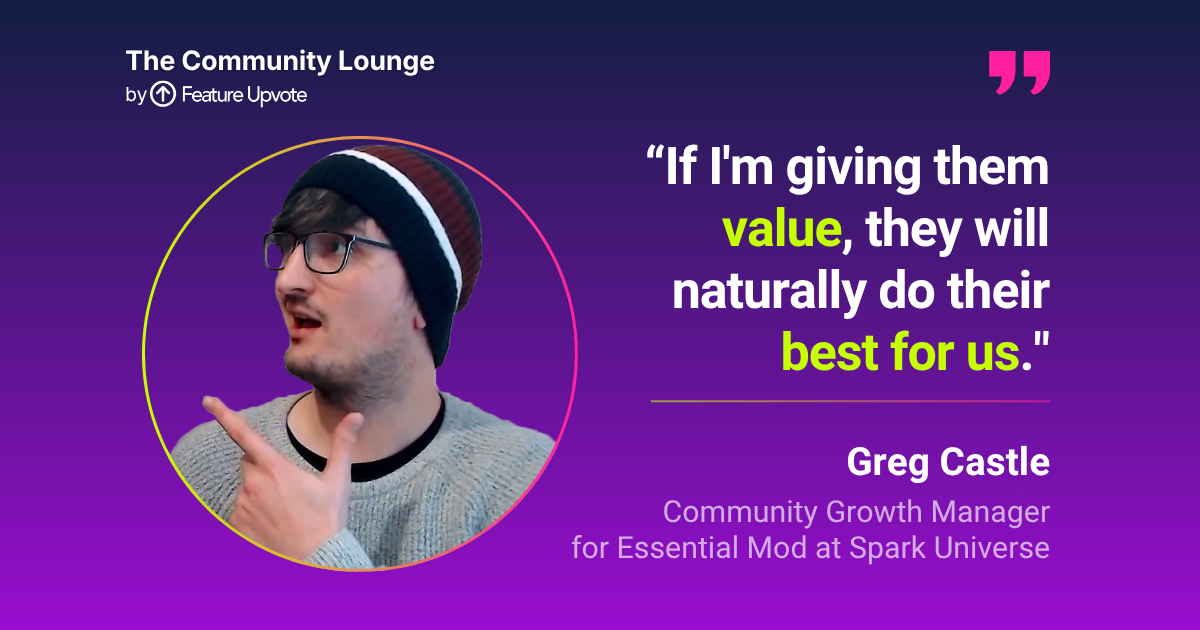
If I’m not giving them value, that’s the way I want it to work. If I’m giving them value, they will naturally do their best for us. Yeah, that’s absolutely the way I like to come about it.
Steve McLeod
Mm-hmm. That’ll be a great leading principle in general for community management give them value. Greg, we are running out of time, but I still have one really important question for you. The most important question. What game have you been playing lately?
Greg Castle
What game… So I, this last weekend was my wife’s birthday and we took a little weekend break away just to vanish into the countryside as you can do here in the UK. But we’re both big gamers so we took our Switch and we took our Steam Deck. My Steam Deck game of choice is still The Bazaar. I play it quite a lot. I was the target audience for it and I guess I still am.
Steve McLeod
Ha ha
Greg Castle
It plays pretty well on that. I’m also a big social gamer, that’s probably one of the many reasons why I ended up being in Community Management. So I bounce between a bunch of different social games. Games I can play with my friends, like i’m a big Dota player, Guild Wars, Overwatch is the current one. So yeah, that’s my other. I’m bouncing between those two. I guess also, I recently watched, who was it, watched Carolin Wendt’s interview a couple of days ago.
Steve McLeod
Oh yeah, from the Witcher.
Greg Castle
Yes, and she wanted to give an indie shout out, so I’ll also do an indie shout out. And you also, we were talking before the podcast about a game you were looking forward to play that got released before, during recording, but when the video was out, it was already released. So there’s a game called Teamfight Manager 2 that’s going to be released in about a week’s time, built by a team of two from, I believe they’re from Korea. And I’m a massive, massive eSports fan, you know, I got my start in shoutcasting for esports.
And it’s looking to be a really good eSports manager, we’re kind of lacking at the moment. So I’m going to lose a lot of time to that at some point after this video goes out.
Steve McLeod
You know, I what I should always ask people for an indie shout out. I didn’t quite catch the name of the game. Can you say it again?
Greg Castle
Team Fight Manager 2.
Steve McLeod
What I heard was teabag and I thought no it’s probably not the name of the game.
Greg Castle
I do love tea, not to fit the stereotype, but not quite that much.
Steve McLeod
A true Englishman. Okay, that’s all we have time for today, Greg. thank you again for being on the show.
Greg Castle
Thank you very much for having me, it’s pleasure.
Steve McLeod
And where can listeners get in touch if they’d like to know more about what we’ve discussed today?
Greg Castle
I’m always happy to chat over on LinkedIn, you can find me there, or my Bluesky, is Dibbuk232, which I’m sure you’ll link below.
Steve McLeod
I will indeed. Okay. Bye, Greg. Bye, everyone.
Greg Castle
Bye, thank you.