
Subscribe to The Community Lounge podcast
(You can also watch this episode on YouTube.)
Today’s guest is Chandler Wood, currently working with Skilltree Marketing. Chandler started his community management career truly in the deep end. He left games journalism, where he’d spent about a decade, to join Avalanche Software in his hometown of Salt Lake City working on Hogwarts Legacy. He only left the role years later when love took him to New York.
We chat about Chandler’s “oil in the engine” philosophy of community management — being the translator and connective tissue between brand, product, and audience rather than a mascot or figurehead. He shares what it meant to be a community manager for the studio as much as for the players, how he helped Hogwarts Legacy build its own fandom identity distinct from the wider Wizarding World audience. Chandler also gets into the power of listening, making broadcast content feel one-to-one, and his best advice for first-time community managers.
Games mentioned in this episode:
Find Chandler on:
The Community Lounge is brought to you by Feature Upvote – Painlessly collect feedback from your players. More insights, less noise.
Subscribe to the Community Lounge newsletter and get notified of new episodes and articles.
Transcription
Steve McLeod
Today I’m joined by Chandler Wood, currently working with Skilltree Marketing. Now, Chandler started his community management career truly in the deep end. His first game as community manager was Hogwarts Legacy.
And it must have been a positive experience because Chandler only left that role some years later due to getting married. Welcome to the show, Chandler.
Chandler Wood
Thank you, thank you. Yeah, yeah. It was a crazy experience to get to do that and then also to like you think you have your dream job, you think you’ve like you’ve made it, this is it, and then like you realize you have your whole life ahead of you too and crazy twists and turns and love took me in a different direction and moved from Salt Lake City, Utah to New York and left that job. wouldn’t change it for the world, but I do miss it a lot.
Steve McLeod
Long time ago my girlfriend and I travelled from Salt Lake City to New York directly. And then man, is that a big change? Is it like, wow.
Chandler Wood
Yes. Yes, it is.
Steve McLeod
So Chandler, I’m gonna go straight into the deep material here. Normally I do these, we kind of slowly ease into the hard questions, but I think you’re the right guy that I can do things in reverse order. So I’m gonna quote something that you wrote to me before our call.
You wrote to me that one of your central pillars at WB Games, that’s the publisher of Hogwarts, was giving people a name and a face to connect with the brand, not as a mascot or figurehead, but as a cross-functional translator across teams. And you also wrote community is about communication and translation and being the switchboard that connects all pieces of brand, product and audience. There’s a lot there to unpack. Would you like to give it a shot and tell me a bit more about this central pillar?
Chandler Wood
Yeah, yeah. I I guess when I when I first joined Avalanche, I didn’t fully know what to expect. I’d come off of being you know in games journalism for about a decade. So I’d been on the media side of things, I’d been to conferences, I’d been to development studios and and events and preview events and review events and all these things. I’d interviewed developers.
But there’s just nothing like actually getting into it and being on the development side and in a studio to really understand what that is. And so I was thinking, you know, yeah, I’m a passionate fan. I’m I I can step into this.
What I found when I started at Avalanche was that it wasn’t just about the community. A lot of things on community management people really focus on the community, the audience perspective. But I spent a long time getting really intimately knowledgeable about the product, playing the game and not just playing the game, but understanding the team and meeting the team and understanding, I was almost a community manager for the studio as well, the community of the studio, as much as I was the the community of the game and and even the Wizarding world and Harry Potter franchise in in many ways and bringing all that together.
And the longer I was there and the more that we did with everything, the more I just wanted to be the visual that comes into my head is like oil going through an engine. You know, you have an engine, it works. There’s all these pieces that that work. They’re doing their things, they’re the experts. They know how to do what they’re doing in the game engine and building the game or writing the game, and the community is passionate people. In fact, I would not even say that I was the most passionate Hogwarts legacy fan. I don’t think a community manager needs to be the most passionate fan. They need to be a fan, but they don’t need to be the most passionate fan. The community absolutely already handles that.
Steve McLeod
Mm-hmm.
Chandler Wood
That’s great. I want community that is more passionate than I am about the thing that that you know we’re trying to work with there. But I really see myself as this, you know, again, that visual of that oil just moving through the engine and helping all of those pieces come together without friction and work together in a way I understand all of those pieces. I don’t necessarily do them all. I’m not an expert at each of those things, but I understand everything.
And that’s kind of the central pillar that that I was leaning on where I was like there are brand experts. I can come to be a brand expert. There’s publishing experts. I can come to be a publishing expert. There’s development experts and engineers at the studio and again even the community there are community members who are doing things far beyond what I could do, but really being able to understand each of those pieces and going, okay, what are the threads? How can I pull this in here? How can I pull this in here? How can I make it all work together in a really frictionless way?
Steve McLeod
I like that. Is it metaphor the right word? So much. That community manager is the oil that goes all through the engine so that all the parts can work smoothly together in harmony. The oil’s essential. You don’t know if it’s there doing its job, you don’t notice it. Maybe the metaphor’s not great there, because I think community managers should be should be noticed. But certainly if it’s not there, you notice it when your engine just stops working. Yeah. Yeah. That’s fantastic.
Chandler Wood
Ha ha Yeah. You definitely notice it, yeah.
Steve McLeod
You mentioned that you were also in some way the community manager for internally, if I understood correctly, for the team that was creating the game. And it must have been a massive team, surely.
Chandler Wood
Mm-hmm. Yeah, yeah.
Steve McLeod
Tell me tell me more about that. ‘Cause I I usually think of community management as something that that reaches outside the studio and not so much within the studio. So how how did you function as a community manager inside the studio?
Chandler Wood
I’m gonna put pull another analogy in here ’cause I love analogies and metaphors and visuals and everything. But immediately as you were saying that, I got the the image of Spider Man, you know, doing the thing with his webs on both sides, like pulling the things together and ’cause when you said reaching outside of the studio and reaching into the studio, I really think it’s both. It’s really reaching in both directions and trying to pull and hold those things together.
And really I helped what I feel like I did and I hope I did and in talking to people I at the studio, I think they gave me a lot of feedback that I did do this well, but was really get them just as excited. You know, when you’re head down on a project and you’re working on something and you are so focused on, you know, let’s say it’s combat design or let’s say it’s designing the world or whatever like piece of the game that you have, there’s this really myopic view of what you’re working on, what you’re doing.
And particularly in a game as big as Hogwarts Legacy and with a team as big as we had there, you don’t really see a lot of those other pieces. And you also don’t really see a lot of the community and the community excitement. And it’s really easy to get either super focused into what you’re doing specifically, or you know, maybe feeling bad about something because something you’re doing’s not exactly working out, or you know, you’re just frustrated about this one little piece and this one little thing.
And again, it was it was nice to be able to bring that, that energy to not only allowing them and the studio overall, I can’t take full credit for this.
Steve McLeod
Yeah, sure.
Chandler Wood
The studio overall was really good at being very collaborative. And coming together and helping everybody understand the pieces that we’re all working together, having regular checkups in with things like so that whoever’s working on, you know, again, say combat design is not just so focused on combat design that they have no idea what’s going on with story or world building or anything like that.
But also pulling in that that like outside perspective of of here’s what people are saying about what they saw in the latest trailer about combat design and trying to bring that back to the team either for feedback for improvement or just to to get them excited and be like, hey, people are loving what they’re seeing. Keep it up, keep going, you know, that that motivational drive to get across the finish line.
Steve McLeod
Just make sure I understood. So Hogwarts Legacy is the game, the studio that created it was Avalanche. You mentioned Avalanche, right? And WB Games was the publisher. And you were working for at the studio or the publisher?
Chandler Wood
I was at the studio level. so I was I was embedded within the studio that was in… was still is in Salt Lake City, Utah. so yeah, that that all also offered me like a really unique lens to for example, the social team at WB Games is based in in Burbank, and they’re out of the publisher.
And so there’s a lot of again that that like connective tissue in those just making sure that those lines of communication are actually happening so that instead of the social team just kind of putting out whatever they’re seeing while they’re kind of especially being in two different locations, California and Utah, and not actually being inside and as part of the studio, there’s a little bit of like a looking in mentality, I think, where it’s like you can’t really see what what’s going on in the studio if you’re not there.
Part of the reason why you know moving to New York unfortunately meant I couldn’t really do this job to my fullest ability. and I needed, you know, they need a community manager who’s there in the studio because I could just wander the halls and you know, wander the ninth floor and then wander up the stairs to the tenth floor and wander around and ask people what they’re working on and how things are going and some of those just hallway wanderings or meeting by the you know the water cooler talks again at during a lunch break or something would get us some of the best ideas for what we would then go on to work on.
And it’s just something you just can’t get anywhere else from like a briefing or you know a every three months all hands meeting or something like that. It’s like there’s just that real, What are you working on today? What’s frustrating you? What’s what are you excited about? What thing do you really want people to know about what you’re working on and those natural conversations?
Steve McLeod
Yeah, I think I’m completely on your side there for the advantage of working in person over remote. I at least from that perspective, My company is fully remote and I really crave sometimes I wish that we were all working in the same building, even for a week at a time, because you just it’s everything’s so much smoother. It’s the oil in in the engine again. Yeah.
Chandler Wood
Ha ha. Yeah. Yep. Yeah. I definitely appreciated the moments when, you know, I could the the ability to work remote, that hybrid, where I can just sit down and lock in and do work. But there’s nothing like the ability to actually be there at the studio seeing people, having a dedicated day. We had we had a couple days that were dedicated days in office. So we knew everybody was gonna be there. and it made it really easy to kind of get those, make the rounds and get those conversations in.
Steve McLeod
Thinking that maybe I should have an occasional in person day for my own company. The problem is not everyone’s in the same city. So the legacy, the Hogwarts IP is of course, like already with fanatical fans. So you’re having people come to the game who are already like enormous fans, and I know you don’t actually have the experience of not being in that situation to compare it to, but maybe you can imagine like what is it like being a community manager when the fans who come in to play the game for the first time already know so much about Hogwarts and Harry Potter and so on.
Chandler Wood
Yeah, that was an interesting challenge and something where when I again when I first started, a lot of people were like, this is gonna be the easiest job for you because it’s alright, you already have a built-in fan base, it’s fine. And I what I wasn’t content just living with that. I think one of the things that I really wanted to do was bring people in as fans of Hogwarts Legacy uniquely.
The benchmark that I look at is that even within fandoms, there are lots of things that if you just assume they’re gonna be fine and everybody’s gonna love it because it’s just part of that universe, people don’t. And they can they can really falter because of that thinking, because of just assuming, well, everybody’s a fan of big IP. So whatever we do within this big IP, everybody will love it and they’ll they’ll eat it up anyway.
And I really wanted to create a space where people were fans of not just the Wizarding World, not just of Harry Potter, but where they were uniquely fans of Hogwarts Legacy. And that that fandom could kind of stand on its own in a way too, where you didn’t have to be a fan of Wizarding World or Harry Potter to be a fan of Hogwarts Legacy, and vice versa.
So that focus in building it out kind of as its own sub-brand, really, and sub-community within that. I think really helped drive that focus. But then on the other side, obviously you can’t ignore that huge fan base. You can’t ignore that that massive fandom that’s there. And so I really wanted to lean into acknowledging again what was there, acknowledging that…
I think as a community manager, I mentioned this before, but you don’t want to be competing with your community to be the biggest fan. You want to empower your community to be far bigger fans than even ever you could be. And because we already had that, because they were already there, I was like, all right, let’s step in and continue to empower these people, these creators, these fans.
And there were creators who had been basing all of their content, their entire channels, on leaks that had come earlier and rumours and everything about at that point it was only called ‘Harry Potter Game’. In fact, that’s why the Reddit is called just r/HarryPotterGame, because it was before they even knew what the name of the game was going to be. And they had based their entire channels on just building towards this this one thing basically and…
So we already had that built in and I really wanted to focus on those people who had already given us a lot of that dedication and a lot of that passion. And that was really my I would say one of the main things that I did there was inviting them in. and instead of trying to build a community on my own, kind of invite in because you can’t bring hundreds of people into the studio, obviously.
But, you know, we can bring in one person, Expecto Go, you know, James Whitehead. I was able to invite him in and say, Hey, come reveal gameplay with us for the first time out of the studio and we welcome your community in kind of spiritually in a way, by having you be the one that that’s here and getting that opportunity. We did that a few times leading up to launch with a few creators that that were smaller creators.
They’re not necessarily the big massive names that that you’re gonna think of when you rattle off, here’s the big Twitch streamers. but I think it gave us a lot more valuable communities who were really, really invested in what we were doing.
Steve McLeod
Mm-hmm. I think the evidence of how well you did that is came up when I was researching this episode our interview in advance and I found an episode of a YouTube channel with sorry, what was it XpectoGO, right?
Chandler Wood
XpectoGO, yeah.
Steve McLeod
Is that a XpectoGO half hour he spent talking about you leaving your role there and why you were leaving for love, as he said it. And I think that was a real evidence that you they the community saw what you were doing and you were doing it well. So yeah, well done.
Chandler Wood
Yeah. Yeah. I recently rejoined him on a on a live podcast. He does one called Wizarding Wednesdays, every Wednesday night. that’s about a two hour long just live podcast he does, just chatting with his community, talking about the latest news out of the wizarding world. And so I recently joined him and it was just a really cool thing, like more than six months later to come back to that to still feel kind of the love from the community that was there.
He was, he was one of, if not the first creator that we worked with. And so that’s why when I was leaving, I kind of gave him my goodbye letter and my farewell and said, Hey, you know, I’m not asking you to do anything with this, but I’m just I wanted to let you know that I’m leaving and here’s why and everything and if you want to do anything. And he created that video and that video, I think, I told him is I think there’s no better resume for me.
Steve McLeod
Yeah.
Chandler Wood
I can have a resume. I can list out all of the things that I did there and well I did this and it got X number of views and X number of sales and all this stuff. But I think the best resume that I could ever ask for is just to send somebody that video and say, Well, with everything I did, here’s the impact that I had on the community. And that’s just so special to me.
Steve McLeod
I agree. Now completely changing the direction of this interview, let’s go back to what would normally be the beginning of the conversation and tell us how it started for you, your path into community management. You did mention you did earlier that you were a writer in the games industry. Is that a good place to start or should we even start before then? It’s up to you.
Chandler Wood
Oh man. Well, I mean, yeah, if we go way back, I mean, I’ve always been into games. I think it starts with passion. I think it starts with really like caring about something. I’ve always been the type of person who I get highly, highly invested in things. Even before I was in games journalism, I worked at Guitar Center for a period of 10 years. There was some overlap there while I was writing. but I remember at Guitar Center.
When Lost was airing on TV and the like the water cooler talks there and the excitement and the passion that people would have when each new episode would drop and there’d be all this conversation and we’d all be online talking to each other or at work talking and just theorizing and diving deep into whatever we could.
And I think that’s where a lot of that really started for me was long before I ever thought of it as a career. It was just passion and it was just really, really caring about things. So yeah, then I became a games writer. That was not the most lucrative time in my life. But again, it came from a place of passion, came from the games were something I really, really loved and I really, really wanted to make a part of my life and through that I was I was able to meet a lot of really cool people around the industry and make a lot of really great friends during that time.
And I think I kind of knew… Hard to pinpoint exactly when, but I think I kind of knew that my goal was always to get into the games industry to be on the development side. I just didn’t know how or what exactly that would look like. And so yeah, when this opportunity came up that was literally in my backyard, I’m was like, they’re making the, you know, at the time again, the Harry Potter game, seven minutes from my house at the time, I was like, I can’t.
Steve McLeod
This is clearly a job for you.
Chandler Wood
Yeah, exactly. This is it’s written in the stars, like this is the thing that that has to happen. And so yeah, that’s kind of where, where all that stemmed from. I haven’t gone to college. I originally actually went to vocational school for medical assisting long time ago. And clearly have not done anything with that. So took a completely different yeah, yeah, completely different direction.
Steve McLeod
Well what a career so far.
Chandler Wood
So took a completely different yeah, yeah, completely different direction.
Steve McLeod
So so that’s how you got your start in community management and again I keep having to say in amazement that you really started like in such a big, big game. Amazing. So once you started working as a community manager, were you part of a team? Did you have a mentor? How did you learn in those first weeks or months how to actually do your job?
Chandler Wood
Mm-hmm. Yeah, so the my boss at Avalanche was part of that marketing team. We were basically a two person marketing team, marketing manager. His name’s Eric Martin. and he was awesome at kind of taking me under his wing. I’d gotten a lot of experience obviously from leading, an enthusiast website that was pulling in, you know, millions of views.
So there was a lot of foundation that that I had there in in managing communities and in comments and in empowering the passion of readers and people that we would want to come back to the site. You know, because of those millions of page views, you know, what I learned at that time was you’re gonna have your regular commenters. So there were the people in in the comment sections that we would see all the time.
Both good and bad, you know. And clearly that is not millions of people. But if you are cultivating a space where even a small group of people feel comfortable continually returning, continually engaging, It just worked to drive better engagement overall and get you kind of the bigger results that that you want to see.
And I think I brought that same thing into Hogwarts Legacy, where I didn’t have to focus on absolutely everyone on what it sold 40 over 40 million copies at this point. I have not talked to 40 million people as much as I wish I could. you know, really diversifying my time like that just doesn’t work out.
Steve McLeod
Yeah.
Chandler Wood
But really focusing and acknowledging and making sure the people that are there and that are showing up and that are in those spaces are really feeling heard and really feeling seen. And then with everything that we were doing beyond that to kind of make sure that everything felt individualized. It didn’t feel broadcast.
Steve McLeod
Okay.
Chandler Wood
So even if this was not somebody that I was specifically talking to, everything did feel like I was specifically talking to you. And I think that’s I think it’s something that like content creators do ex extraordinarily well.
Steve McLeod
How would one do that? Can you give me an example of how you would make content that feels one to one rather than broadcast?
Chandler Wood
Yeah, it just I think we… Like broadcast is kind of, you know, your big trailer or something like that, which has their places. You definitely want those, you definitely want those things that are just kind of spraying information out there and excitement and big bombastic moments or whatever it is. Here’s one good example. when we initially delayed the game, it delayed from the end of 2022 into early 2023.
I didn’t want to do just the same. at that time it was the meme of every game company delaying a game would do their text post and you’re like, well there’s another text post game delay. And I wasn’t content just doing that. And so we definitely had that in some part. But I also did a video from the studio that was just video of me.
We shot it nicely. You know, it wasn’t just on a phone or anything. It was like it was it was filmed nicely, but it was me like really kind of showing, hey, here’s me. I’m telling you, unfortunately, we’re delaying the game. We really want to bring you a quality product. You’re not just reading text telling you this, I’m telling it to you face to face. So you can believe me or not, but I want to have this conversation with you.
And then giving them an actual release date as well, kind of as the okay, here’s the bad, but here’s the good. Here you have a date now. and I think that that opens a dialogue and starts a conversation in a way that the broadcast type of stuff just doesn’t. It invites people to participate, even if they don’t want to.
It makes you feel like you can because you’re looking at this this one person and you’re like, I can engage with them, with that one person. Again, that that idea of that that content creators are doing this very well, streamers, where even if they’ve got hundreds, thousands, tens of thousands, millions of views, you as a viewer maybe are looking at them.
There’s it’s a bit of a parasocial relationship, where, you know, one sided, but I think it’s important for cultivating that feeling of belonging and that comfort, that comfort and empoweredness of feeling like I as an individual, as a member of the community, could just come in and I can comment or not, but I feel like I’m being spoken directly to. So that’s kind of that that approach.
Steve McLeod
Wonderful. I like that. we’re running out of time, but let’s see what would be a best question to ask in the limited time we have. What tips do you have for first time community managers?
Chandler Wood
Yeah. Listening is I mean, I think you’ve probably heard that one before. Other community managers have probably given that as well, but II will reiterate it and if it hasn’t been heard before, I think it’s very important. Listening is of the utmost importance. It is not trying to have your voice heard. It’s not about you.
You know in that in that quote that you read at the start that was something that I had sent you. It’s not about being a figurehead. It’s not about being the face of things and the and the voice of things and kind of being the mascot or anything like that. It’s about being the translator and such a crucial part of being a translator is listening and understanding and understanding context.
And then being able to translate that back accurately and in ways that you know, if you’re not listening, if you have your own preconceived ideas of what the community should be or what the product should be, or you know, the game or the what whatever you’re working with, whatever it is that you’re trying to communicate out, you’re gonna start to colour how you’re translating things with that. And so really putting yourself aside, putting your own ego aside.
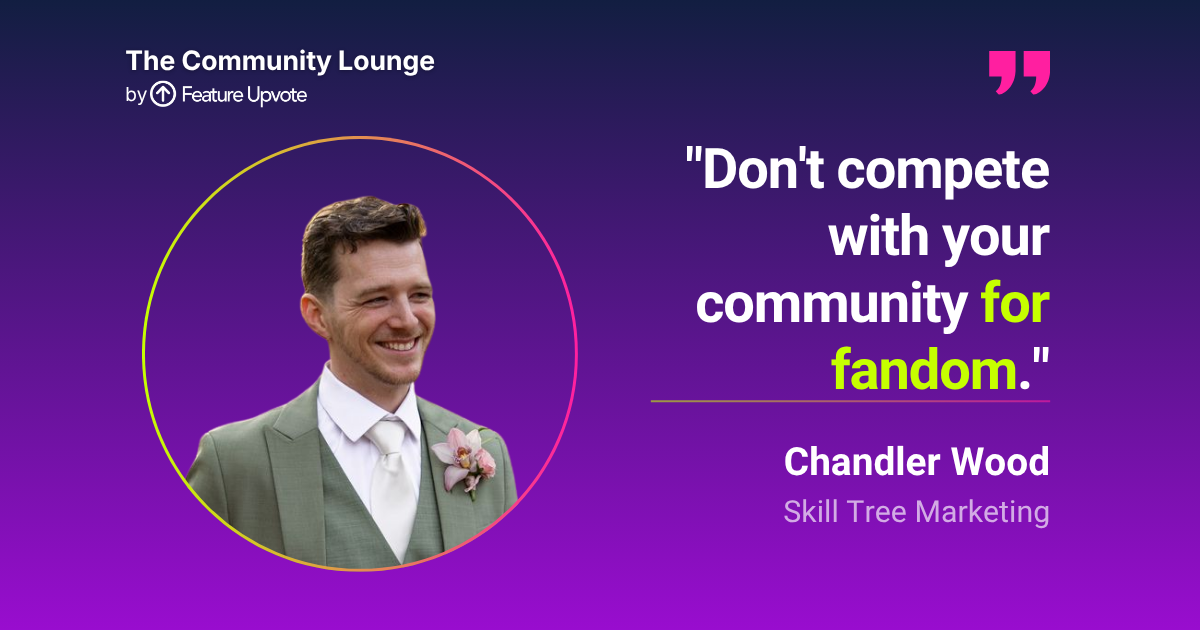
And listening and just having that full understanding, and then not having it be a competition. You know, that’s part of putting the the ego aside as well. I think that I think it’s the third time I’ve said it now, but I think like don’t compete with your own community for fandom and for you know, I’m the biggest fan of this and it’s…
In my mind, if you’re empowering it it’s the same way that that I like to lead a team. You know, if I’m managing somebody or managing a team, I want to empower the people who are underneath me to do a better job than I’m doing and to ultimately and eventually replace me and be able to do things well. Because if not, I’m just a task manager. And in a similar way with the community, I want to empower the community to be bigger fans than I ever could be.
Because that is a force multiplier that is just gonna go out there and again, I can’t talk to millions of people, but they can and they can have their communities and their communities and their communities. And if I can empower them to do that, I think that’s the that’s the best way a community manager can. So yeah, listen and empower your communities.
Steve McLeod
Yeah. And don’t try to outcompete the the big fans.
Chandler Wood
And don’t try to outcombete their their fandom. Yep.
Steve McLeod
Let’s go back to listen. Do you have any concrete examples of how one starting the job as a community manager for the first time goes about listening? What does that mean in concrete and real terms? I mean, it doesn’t just mean sit in the corner and have their ears here, right? So…
Chandler Wood
Yeah, yeah, exactly. It’s, I mean you have to show up where your community is. I think first and foremost is the one of the most important things. You know, trying to cultivate a community space. It’s a bit different if you don’t have a community space and you need to build something. But also understanding your target audience and going to where they are. I think outreach is a big thing.
For example, the Reddit that had already existed instead of trying to create our own Reddit or do something like that or bring people necessarily into our Discord, I outreached to them and I was like, hey, you know, you’ve got a good thing going here. I’m not coming in. I’m not trying to manage it. I’m not trying to step on toes. I just want to let you know who I am. I would love to be a member here. I’d love to participate in all the conversations and being really open to being in that space.
Again, not from a position of authority, but from a position of just being among the community. And then yeah, just reading Reddit, reading social media, Discord, really wherever your community is, and then building other spaces maybe where some of some of them can come into your space as well, and inviting them in there, but not requiring them to be there.
Steve McLeod
Chandler, you’re proof that I see over and over again on this podcast of community managers being really underrated. I think a lot of people in the games industry overlook the role of community manager and what they bring to it. So thank you very much for these great answers. Now I do have one more question. You might even consider it the most important question. What games have you been playing lately?
Chandler Wood
Two. I’ve been running through two right now. Expedition 33. Been very slowly working through that with my wife. ’cause she loves watching it. She loves the story. I think we’re approaching the end finally. It’s been a it’s been a long journey, especially with…
Steve McLeod
Okay. There’s a couple of false ends in that game.
Chandler Wood
Yeah, yeah. And and we’ve been we’ve been long distant we before we got married we were long distance for two years, so we couldn’t play it that often together. So it was it was tough. And Final Fantasy seven, rebirth, the part two of the yeah. Yeah, so working my way through that as well.
Steve McLeod
Okay. Fantastic. It says a lot about what type of game you’re into, those two. I deliberately didn’t play Expedition 33 because it sounded too much like a type of game I would play and I just don’t have enough spare time to get caught up in a game. And then earlier this year in February my family went away for a week and I downloaded the game and had it ready to play.
The moment after I dropped them off at the airport. I came back home, started it, and pretty much just played it for a week and finished it just the day they came back. And it was a pity because I think it’s a game that really warrants playing the way you’re doing it and savouring the story as you go. At times I’m just like, Come on, get past this cutscene, get past this video. I need to keep playing, I’m running out of time. But yeah, good two good answers.
Chandler Wood
Haha.
Steve McLeod
Okay, let’s wrap things up. it is all we have time for today. So thank you again for being on the show and really, really you’ve revealed a lot of that you really think very deeply about your job. so I’ve appreciated that.
Chandler Wood
Thank you.
Steve McLeod
Where can listeners get in touch if they’d like to know more about what we’ve discussed today or they’d like to be in contact?
Chandler Wood
Yeah, I mean professionally LinkedIn is the is the best place. Just Chandler Wood on LinkedIn.
Steve McLeod
I’ll make sure we have that in the show notes.
Chandler Wood
then I’ve got my website as well is ‘chandler-wood.com’ yep.
Steve McLeod
Okay, I’ll make sure that’s also in the show notes.
Okay, thanks. bye Chandler.
Chandler Wood
Thank you so much.
Steve McLeod
Bye everyone.