
Subscribe to The Community Lounge podcast
(You can also watch this episode on YouTube.)
Faye V returns for part two of our chat. Topics include:
- Faye’s argument for open development.
- the “chasm of empathy” metaphor for the gap between developers and players.
- why hiring a community lead early, not six months before launch, is best.
Games mentioned in this episode:
- World of Warcraft
- Final Fantasy XIV
- Lord of the Rings Online
- EverQuest
- Asheron’s Call
- Ghost (Fantastic Pixel Castle, unreleased)
Find Faye on:
The Community Lounge is brought to you by Feature Upvote – Painlessly collect feedback from your players. More insights, less noise.
Subscribe to the Community Lounge newsletter and get notified of new episodes and articles
Transcription
Steve McLeod
Welcome to part two of my interview with Faye V with really bad continuity. In part one of our conversation, we covered how Faye’s background as a circus performer and her degree in psychology both influence her work in community management. It’s very interesting and I highly recommend listening to part one if you haven’t done so yet. However, maybe this episode will stand alone. We’ll find out. We ran out of time during that interview to talk about all the things we wanted to cover. So here we are today with part two. Welcome back, Faye.
Faye
Thank you so much for having me back. I had such a fun time in our first episode that we immediately scheduled a second one.
Steve McLeod
Despite it requiring because of time zones, it requires you to be up and bubbly early, right?
Faye
Well, the sun’s out, might as well, well, as much as the sun is ever out in the Pacific Northwest. So, you know, it’s a nice, it’s a nice drizzly day. So yeah, why not? Right? Let’s get going.
Steve McLeod
So the original plan, well kind of the idea I had is that we’d splice these two recordings together to make one really long episode. My producer talked me out of it. He thought it’d be better as two separate interviews, which is good because we’ve both ruined the continuity. You went and got yourself a haircut, the fringe seems to have changed, and I shaved.
Faye
Completely. did. Yep. Well, I just, you we tried, we did our best, right? We’re wearing the same shirts, but yeah, there are some differences. This is what happens when you’re telecommuting, you don’t have a full production crew to keep you in line, as it were, right?
Steve McLeod
Exactly. So, listeners, if this bothers you, my full apologies. I have a feeling you couldn’t care less about continuity. You just want to hear the continuing wisdom of Faye that we started with in the last episode and we’ll continue today. So, Faye, there were four things that we had pre-discussed that we didn’t get to cover last time, and let’s see how we go today. We already agreed that we’re gonna start off with your opinion on the case for open development in the video games industry, but maybe even broader, you suggested. So let me have a, make a case for why development should be more open.
Faye
So I think let’s start with games, right? I have spent a lot of time playing and working on MMOs, which famously, think MMO players are some of the most dedicated, but also the most particular about what they want in a game. And that makes sense when you think about the sheer investment of their time and money that MMO players will put into an MMO.
We’re talking about people, I think there are people who have been playing WoW for like 20 years now, right? And they’re still with the same guilds, they’re still with the same, you know, characters, they’re playing on the same servers with the same people that they were playing with 20 years ago, and that’s absolutely amazing. But when you’ve put 20 years of something, of time into something, that’s like paying rent. You live there now.
Steve McLeod
Yeah.
Faye
So to a certain extent, I think about MMOs not just as like a game that we’re asking people to play, but also a home, kind of almost like an apartment building. We’re saying like, come move into this, right? Like spend your time and your money and make friends here and invest in the story and the world and the character and the clothes. And, you know, there’s all these jokes about like what’s really end game in MMOs. I play Final Fantasy XIV a lot right now. So the right glamour and housing, right?
Like, making your house look nice and making sure you’ve got good clothes. But when people put that time and effort into something, there’s a certain extent that I think that they want to know how it’s being developed just so that they feel like their time and their money and their social connections are being respected, right? I think of the ways when MMOs get shut down, how devastating that can be to the community that plays them.
And just how hard that can hit those social connections, those friendships, those relationships, right? You’re playing a single player RPG, there’s absolutely community around it. You go and find it on Discord, you can find it on Reddit, before Discord and Reddit, you could find it on bulletin board systems or IRC, just dating myself significantly there. But when the connections are formed in the game, when the platform goes away, it’s hard to rebuild those.
Steve McLeod
Yeah. If not impossible.
Faye
If not impossible right, like if you don’t if somebody is logged off two years ago and then the game goes away you may not be able to find them again and that can be really heart-breaking knowing like even if they never logged back on as long as the platform is still there the game is still there there’s a chance do you know what i mean?
So when I think about open development, especially from building an MMO from the ground up in this day and age, which could be really, which can be really, really hard. I think of that as respect. Do you know what I mean? I think of that as saying like, here is what we’re doing. Here’s how we’re building this. And here’s how we are setting the foundation for you to have a game for a long time.
Now, obviously, no games can last forever. That’s just how technology works, unfortunately. But I think when you are building an MMO, you’re building for longevity, and the promise for longevity should be there. To be clear, when I say open development, I don’t mean telling everybody what the story is immediately. Obviously, there are ways to show what you’re working on that don’t involve spoiling everything. People still want to…
They still want to discover the story for the first time. But when I was working on Ghost at Fantastic Pixel Castle, one of the things that we did was we showed a lot of our world building, even if we didn’t show the story. And we spent a lot of time talking about what to show and what to keep so that there was still that sense of discovery and that sense of excitement as people got into the game to discover the story.
But one of the things, again, when you’re building a world for people to live in, you almost want the world to feel really familiar so that they have, like, they feel like they already live there before the story starts, right? Like, you’re not asking a newborn to play an MMO. You’re asking somebody with context to go have this adventure and become this hero.
So we spent a lot of time showing how we built our different biomes. We spent a lot of time putting out there different character, like archetypes we were thinking of having. We showed off our very first class, actually. We had a big kind of push marketing beat around that to show how we built this class, not just to say like, this is our very first class because you know, an MMO, doesn’t get to do that very often. So that was really fun. But it also talked, it also showed how we’re thinking about building classes. We wanted to make it really clear what kind of game we were making.
And what the experience was going to be like so that people could take a look at us ahead of time and say, like, yes, I want to follow this along or no, you know, maybe this game isn’t for me. And that second part sounds very scary, I think, especially to investors or business people who are really wanting to, you know, kind of get their return on investment in a game like an MMO, which is very expensive to develop and takes a lot of time. But.
The response I’d have to that is not everybody is going to play every game. That’s just the nature of games. And with a thousand games coming out every single day, it’s, you just have to accept like this game is not going to be for everybody. That’s okay. I think there are certainly people in the world who have tried WoW and bounced off of it or who have never played WoW. And that’s still the most successful in the mode of all time.
Steve McLeod
I don’t understand those people, but yeah, they exist.
Faye
Well, you know, I think, I think as the generations move, move on, there’s that’s, yeah, but yes, certainly, I think, I think of a certain calibre of the Gen X, Millennial, like maybe early Gen Z, everybody who loves MMOs has touched WoW at some point, which obviously that’s, that’s like the North Star success, but there are so many levels of success underneath that.
The other thing about open development that I really love is the way that it just builds investment and humanizes development.
Steve McLeod
Yeah.
Faye
So at some point, we as an industry, I feel stepped away from transparent communication and what that means now is that there are a lot of people who work on games who don’t have the same connection that maybe a generation, generation and a half ago used to have. Because it used to be that game development companies were pretty small and you would just go get in the forums with your players and you’d ask them questions. know, the bullets and board system days, forum days, like those are in a lot of ways I miss those days.
But, and this happens when industries get bigger and products get bigger and budgets explode and things like that. But there’s that sense of like intimacy of development that gets lost. But what that creates is I call this the kind of the gulf of empathy or the chasm of empathy. So that there are people who are kind of playing on one side of a canyon and then there are people who are making the game on the other side of the canyon and there’s this giant communication gap between them and they can almost see each other across on the other side.
But when you can’t get close and there’s no way to cross over that chasm it creates a sense of lack of humanity. We don’t see the other person on the other side of the screen. So it’s hard to imagine who might be making this game and why the decisions are being made. And with open development, go ahead.
Steve McLeod
On that metaphor of the chasm or the canyon, I have this idea of like a really rickety swing bridge that that’s better than nothing, you know. Even that is a way in which people can start to approach each other, but this is a metaphor that’s doesn’t make any sense. But if you don’t do it well, then maybe people plummet to their death, not literally. So is it hard… So what I’m suggesting is it hard, it’s probably hard to do well, what you’re suggesting.
Faye
I think one… Yeah, it is. It’s, it is hard to do well, because I think what’s happened, and I think a lot of people who work, especially in our job in this, in this industry can speak to this like, almost immediate distrust, right? We get out there, we try to tell players what we’re doing, and there’s this like, oh, I don’t know. And, and, and…
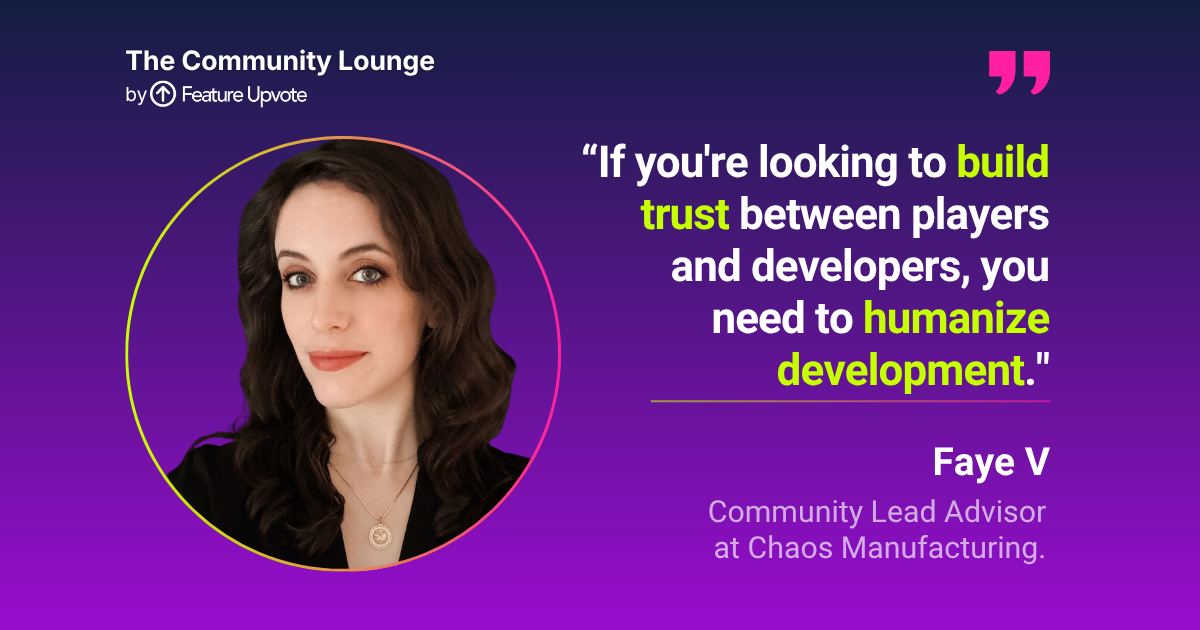
You feel like there are all these almost conspiracy theories that get built up about why decisions get made in games. And the reason for that is because there is an absolute lack of foundational information as to how a game gets made. So fundamentally, if you’re looking to build trust between players and developers, you need to humanize development.
You need to show these are the people who are making your game. This is why they make the decisions they make. And if we’ve done our job right, what happens is even if we make a decision they don’t like, which has to happen, right? That will happen at some point. We can’t make everybody happy. And at some point, something has to happen. Technology changes. There needs to be a graphics update. I don’t know.
You can’t bring a voice actor back for the same character, so that person needs to change, even though the first person might have been super beloved, right? All of these things happen in a live service game. At some point, if you’ve been really transparent and straightforward about why you’re making the decisions you’re making, when you make that decision that people aren’t happy with, they at least believe you when you tell them why you did it, right?
Steve McLeod
Yeah, yeah.
Faye
And I, I think it’s just about, it’s about respect and it’s about respecting the people who are putting the money and time into the live service experience. It’s also about respecting the people who are putting all of their time into making that happen. You know, this is a way of crediting them. It’s also a way of letting them speak for their own decisions and their own expertise. I think, I think open development is really powerful in that way.
Steve McLeod
In practical terms, are you talking about something like a devlog or a you- a series of YouTube videos or whatever, TikTok, Instagram?
Faye
Yeah. I think it is going to be different from studio to studio and game to game depending on what you’re making. But I also think that if you’re going to do open development, you’re really committing to that. And so there are people who prefer to read blogs. There are people who prefer to watch YouTube videos. There are people who prefer to scroll through 30 sec-
Like tons of 30 second videos, one minute videos on TikTok, because that’s just the way that they want to process information. And so I think if you’re doing it, having a sort of a multi-channel approach to make sure that people are able to get the information that they want in the method that they want is the way to do it. You can’t approach it a little bit and then decide, that didn’t work and stop, right?
Steve McLeod
Mm-hmm.
Faye
You have to, I believe in the way that that makes us most successful is to say, okay, we’re going to, we’re really going to show people a lot of behind the scenes. We know the game is going to be ugly. There’s gray boxes. There’s a lot of block out art. There’s stuff that’s not going to be there. And our best way to explain why that’s there and what we’re doing and why we’ve chosen to develop in the order that we develop is to have a couple of blog posts.
We’re going to do an AMA on Reddit, we’re going to have a live stream where we show, you know, developer gameplay on Twitch. We’re going to do a Q&A with some, you know, content creators that we’ve brought in to early development, let them ask questions as well, because often the, you know, especially these days, content creators, streamers, they’re very much like the voices of the people in that way.
Steve McLeod
Right.
Faye
And so like getting them in early, having them, you know, walking them through the feedback process that also helps to make it feel like, know, so often what we’re doing with playtesting, we’re bringing in our friends and family and it’s a group of 20 people and that’s who’s testing our game for like five years, right? This kind of helps keep play testing from turning into like a clique or a secret society.
Steve McLeod
Mm-hmm.
Faye
And there are so many people who are excited about wanting to playtest the game early, who have never had the opportunity to do that. So if you are building that rapport with the players with open development, even if they’re not able to come play test, can still, they still have that opportunity to take a look at what you’re doing and say, you know, here’s what I think, or why, or ask their questions. Why, why did you choose to develop in this way?
Which allows for that, again, they’re able to give their thoughts, they’re able to give their opinions. I want to be clear, open development’s a lot of work. It is a lot of work.
Steve McLeod
It sounds like it. It sounds that’s what I was thinking. It’s like as you were talking like that’s how often are we gonna do that, these blog posts, these influencer AMAs? That’s because you well, you basically need a dedicated community person to do all this.
Faye
Yeah. You do, you do. And I think that that’s probably one of the most powerful things that a studio can do early on. So often our position is brought in, we want to finally do our beta test. we’re working towards launch. And at that point, if you’re getting ready to launch, if you’re in your six months to launch and you’re hiring your community manager, I think that’s too late.
Steve McLeod
Yeah, yeah.
Faye
I think… And, but that is sort of the standard right now. But what that means is that you don’t have somebody who is as immersed in the game, in the studio, in the message of what you’re building for the entertainment experience that you’re building, who is comfortable serving as that bridge across the chasm of empathy. And so that’s how you get that rickety bridge.
Which maybe sways in the wind, that’s when people fall off. And it’s your, sort of, in my opinion, you’re not always setting the game up for success. So yeah, it’s you’re hiring a community, a community lead very early, you’re working with them constantly on what the what the conversation approach is. And more than that, your, your community lead should feel really comfortable, and this is, this is what I’m about to say might be a little bit spicy, but your community lead should feel comfortable helping to prep the rest of developers to go talk to the players rather than them being the only point of contact.
Because I think that rickety bridge problem that you were describing before is exactly the problem we face in our industry where there is one very bottlenecked, somewhat fragile point of communication. And it’s very easy to burn that person out. And then you don’t have a bridge.
Steve McLeod
You’ve answered two questions that I’ve asked other people through the series of podcasts. One is what do you do when you’re a community manager on a game that hasn’t been released yet? And you’ve just answered that brilliantly. And the second part is about how you can introduce the whole team. And again, this is a great answer and why you would do that. So I like that very much.
Hey, let’s move on to it’s quite related. So let’s move on to why you think community management is worth the investment from a business case. You’ve just given a really good explanation of what a community manager can do before release. But in general, what’s the business case for a community manager?
Faye
Mm-hmm. Yeah. So I think the community manager is, I’ve joked about the concept of the personality cannon before, right? Where you like turn and you fire and that’s where you need hype, attention or care, right? It’s not just, you’re not just bringing in a cheerleader. You’re also bringing in sort of a combination of like a cheerleader, kindergarten teacher, therapist.
So, I think, especially if you have a live service game, I think it’s absolutely wild that there are live service games out there that don’t invest not just in a community manager, but in a community team, because these are the people who are that bridge over that chasm of empathy, right? They’re building the infrastructure to allow for connection between the community that uses your product, in this case games, but I think lots of products could benefit from this, and the people who are making the product.
And without that bridge and without that infrastructure and without that being really strong and really stable, you don’t have, functionally, you don’t have a community that’s going to invest in your product, in my opinion.
When consumers don’t feel heard, when gamers don’t feel heard, they are far less likely to stick with a game. One of my favourite stories, I grew up playing a game. There are a lot of MMOs, do know what I mean? But there are some that I’ve played, oh my gosh. And one of the games that I grew up playing with my dad, there was a guy in the forums who, every single time a new expansion or a patch was released, he would go in and he would write this long list of complaints of things that he didn’t like and, the game is going downhill and I hate this, that, and the other thing.
But he would never leave. He would always say, this is my last expansion. But it never was. And I think part of that was because at that time, the developers from that studio were really good about getting in the forums and answering this guy and saying, yeah, you know what? That’s a really good point that you said that, or we appreciate the feedback, but here’s why we went in this direction, right? Because part of feedback is not, you don’t always take every single suggestion that every person makes. That’s just the way that that has to go.
But they were so good about explaining why or why not that I think there was this sense of like, I am actually giving feedback to people who care. And they are taking that and incorporating that into the development. They are here for me. They’re building a game that even if I don’t agree with all of the decisions, they’re listening to me and they’re listening to everybody else too.
Steve McLeod
I think I would find that guy very tiring, but I also find him very helpful because he’s forcing your community team to explain this stuff. And that is really useful in the bigger picture. You can then do more content saying, We’ve this is something we’ve changed and this is why. And he’s helped you learn that. I wonder like he’s kind of helpful and tiring, like I said, at the same time.
Faye
Yes, yeah.
Steve McLeod
Sorry, I’ve been running software companies for so long and I know the type of person, who have a lot of opinions and it you know it’s really difficult to have to explain. Like can’t they just assume that we’ve done this for a reason and that we’ve debated this inside our team? But yeah, you need to explain it.
Faye
Mm-hmm. Yeah. Well, I think, you know, people don’t leave games when they feel angry. Anger is an expression of passion, and it can be really frustrating, and it can even be really, like, sad and hard to be on the receiving end of anger. And I want to be clear that, like, I’m not discounting the way that developers are impacted by, like, a game launching or an expansion or a patch shipping into negative reception.
But I think that that negative reception can be tempered if you spend that time building up the humanity of the developers that you are able to help to set an expectation of how feedback is delivered or language is delivered. And the other thing is that I think overall, if you’re building up that connection anyway, you’re less likely to ship a product that is not popular because you know what it is you’re building and who you’re building for.
So, you know, I keep, I love the rickety bridge metaphor that you made because I think like one community manager or not having one and like having people who have other jobs at the studio kind of also be that communications person is… That’s that rickety bridge and not only is it’s almost like the bridge doesn’t exist in some ways because if you come to a giant canyon and there’s one like rickety ancient rope bridge just sort of swinging across it do you trust that bridge is going to get you across?
And so the way that you build trust is by having that strong communication from the ground up, from the get-go, before that chasm becomes super wide and dangerous and scary. And so people can come to that and say, oh, well, this is a really scary chasm. But that is a very well-supported bridge. That’s strong infrastructure. And I feel good about walking across it. Do you know what I mean? That’s, that’s, I love the metaphor.
I love the metaphor because I just keep coming back to that. So the business case, think in a way, especially if you really, if you really want to know what it is, like why your product is or is not landing, why your game is or is not landing with the people that you’re making it for. I think you hire a community person immediately, in my opinion.
Steve McLeod
And get them to build a really solid bridge.
Faye
Yes, yes, yes.
Steve McLeod
On that, that is a really nice segue into my next question. Faye, what tips do you have for first-time community managers apart from building solid bridges?
Faye
Oh my gosh. So I think, you know, again, I joke about the personality cannon and there’s a lot of joking about personality hires right now. But when your job is so dependent on your personality and all those soft social skills, what it’s, you know, we call it soft. We saw it. We call it soft skills. We call it personality. What we’re actually saying is high emotional, emotional intelligence, right? Extremely high emotional intelligence.
And I think that we are starting as like a society to recognize the work, the amount of work that it takes to manage the emotional atmosphere of large communities online. You know, as our world gets smaller and game communities get larger. I think about playing like Lord of the Rings online or EverQuest or, you know, Asheron’s Call. Again, dating myself. And those MMOs were big, are big, Lord of the Rings Online is still going.
But they were nowhere near as big as say, you know, the 12 million people that play WoW or the six, nine million that play Final Fantasy XIV. And I think of the community teams that are dedicated to those games. And I’m like, yes, of course you have multiple teams, right? Because you are managing a global game, taking in that kind of emotional information, processing it and turning it into actionable data, with surveys, with feedback, with play testing, whatever it is that they’re doing, that is a ton of emotional work.
It is so much. And I think the piece of advice, and I’m sure, you’ve heard this before, we’ve all said it before, but the piece of advice is have really, really strong boundaries for yourself.
Steve McLeod
Okay.
Faye
I’m gonna say something that maybe doesn’t get said before, but even and especially in the good moments. So much of our job is like chasing the high of a launch or chasing the high of a new release or a new a big event that’s happening. Or if you work in eSports, you’ve got, you know, regionals and then internationals, world championships. We’re always chasing those big adrenaline drops. And after almost every single one, there’s that giant crash. Right?
So, having a really strong foundation of like, yes, things are going really well, and I’m still going to log off at the right time and go outside and see people in real world and go to bed at a normal time. Even when things are amazing, and you want to be online with your community and you want to be there for like all of their discoveries, setting that boundary there sets such a like strong foundation for when things are not positive for being able to pull back and see the bigger picture.
I don’t know if that makes sense, but it’s like staying true to your own self, regardless of whether things are going incredibly well or incredibly poorly.
Steve McLeod
That’s really good advice. We’ve talked a lot on this podcast in previous episodes about burnout and recognizing it and dealing with it and even avoiding it. But we didn’t ever I don’t think we ever touched on that thing that aspect that even the good times you need to be very careful. I think this is wonderful. I go to a lot of events and they exhaust me and I’ve learned eventually that when I’m done with my meetings for the day, I might go for one drink for dinner.
Steve McLeod
And then I go to my hotel room and I just like play a game on my iPad for a couple of hours and go to sleep early. Because I’ve learned that’s the only way I can keep the energy going and even function when I get back home with my family. So I think what I’m saying is I’ve realized I’ve recognized myself and what you’re saying and that somehow I’ve learned along the way to do this.
Faye
Yeah, and I think that otherwise we’re creating that feeling of like, high, low, high, low. And it’s this massive sine wave of just like, everything is amazing or everything is terrible. If in both areas, you can say like, everything is great, and I’m going to take a break and everything is bad and I’m also gonna take a break.
You create a situation where you’re not just swinging between these two extremes. You’re kind of, it’s like your nervous system has an easier time reaching homeostasis again. So you’re not, you know, feeling like ecstatic or despondent. You’re like, things are good and things will maybe not be as good in the future and that’s okay.
Steve McLeod
Yeah.
Faye
That happens. Every game, especially in live service, every game is gonna release acclaimed expansions and every game is gonna release expansions of people like less. It happens. And so, yeah.
Steve McLeod
Like less. That’s a euphemism. You mean one that everybody pans?
Faye
It happens, it happens, it’s hard. Especially when you have two or three amazing in a row, the expectations become so significant that if you want to do something different or if you want to do something that changes or like yeah there’s turnover right maybe the person that wrote the last two expansions has moved on to an amazing new job at a different company they can’t write the new one it happens so you know that’s having that expectation of being really strict with yourself.
And it’s so hard, right? When the times are good, when you’re at the event. It’s like, whenever I go to a convention, I’m kind of the same way, I think, and I’m seeing all my friends and everybody’s doing like lobby con, we’re hanging out in the hotel, and I’m looking at my watch and people are like, oh, it’s 11, but you know, we’re gonna go, we’re gonna go hang out more. I’ve become very strict with myself. I’m like, I’m going to bed. Yeah, yeah.
Steve McLeod
Yeah. Yeah. Bed is good. Faye, I one final question and that is where do you learn how to do your job as a community manager or in the community management space better?
Faye
Mm-hmm. Oh my gosh. This is a really amazing question because I think people want like, I went to school for this as a very easy answer. And like any job in game development, like there are obviously game design courses now. And if you’re an engineer, there’s quite a bit of computer science and even at this point, robotics work that you can do. But I think community management is not necessarily one that you can learn in a class.
Steve McLeod
Mm-hmm.
Faye
It’s something you learn via experience. Obviously, I do recommend, as I mentioned the last time we talked psychology, having a psychology degree is incredibly helpful, but not everybody needs to have one, I think. Where I think community management is best learned is honestly through mentorship.
Steve McLeod
Yeah?
Faye
And not just within community management. Our job is… I often joke that like, what do you do as a community manager? It depends on the studio that I’m with, right? Sometimes I am a full suite marketing professional. Sometimes I’m very focused on community. Sometimes I’m on the trust and safety side, which could even be seen as more legal, right?
Sometimes, you’re under digital marketing, sometimes you’re under PR, sometimes you’re under business development. It really depends on the studio. So having a strong mentor in multiple different parts of development is really helpful, I think. I have people in production that I really look up to, who I go and talk to and I ask questions about why this decision is made or how they take in feedback. People in marketing that I really look up to that I ask, why did you design this campaign this way?
I will always point to legal, like having a mentor in the legal department is going to be really important because when you’re talking about how we collect data on people, and you’re talking also about like, how we manage crises, or how we manage, you know, and it’s funny, like, this sounds like I’m suddenly the no fun squad, right? Where it’s like, we have to plan for crisis management, we have to plan, but the worst case scenarios on the internet can happen.
And having somebody who is very aware of everything from like what IP infringement or breaking terms of service looks like to like what maybe a more dangerous situation on the internet could or could not look like can be really helpful for helping us again, like regulate in terms of what is actually a big problem versus where can I step back and go like, you know, this feels intense, but it’s not actually that big a deal.
I’ve really just loved being able to talk with the lawyers that I have worked, been very privileged to work with in the past. Every single one of them also just wants to help all the time, genuinely. I want to put that out there. They are wonderful people. And then, yeah, business development and production are the other two. think business development really spans just sort of everything in games, developing the business.
Steve McLeod
Yeah.
Faye
But understanding why a financial decision made or why a delay might, you know, why a patch might end up being delayed or something like that. Understanding the process by which a studio is run allows us to better explain to our community why our studio is being run that way, if that makes any sense. If our job is to communicate the story of development, which I do believe it is, not just the game, but the story of the development itself and the studio, we only get to do that if we actually understand the studio and the game, the development of the game itself.
Steve McLeod
So these mentors that you seek out, are they typically for you inside this studio or the publisher that you’re currently working for?
Faye
Yeah, that’s where I’ve always started. And I think that, you know, I mean, I always think that’s a very good place to start, right? Like once you get integrated into a studio, your direct report, the person that your boss is, like, because presumably you have a boss. If you do not have a boss, you founded your own studio and I can’t give you advice. I’ve never done that. But I think, you know, once you’re in a studio, like talk to your boss all the time, all the time.
I feel like I need to give a shout out to my boss from FPC, John Spector, and our studio founder, Greg Street, because without the two of them, I still bug them every single day. FPC has been unfortunately closed for a little bit, but I am constantly asking them questions about why this happened or what’s going on with this game or, you know, things like that. And it’s and God bless them both. They’re so happy to answer me all the time over Discord.
But I think that, you know, they’re so established that they have seen so many patterns before that even if they’re not on the inside of a game, they can give really interesting insights as to like what happened there. And then beyond that, I’m gonna, this might sound a little bit kind of terrifying to the introverts amongst us, but going to events and just connecting with people, you’re gonna make friends.
Steve McLeod
Yeah.
Faye
You’re gonna make friends, ask them who they learned from. Ask them, can you put me in touch with them? Can I ask them questions? Can you set up a call? And it might sound, A, like a lot of time committed and it is. But also, you know.
When I think of the people that I look up to in community management, I want to also understand like where they where they learned and what I can learn from them and who they learned from too. Like what experiences they had and what connections they had that got them this experience. So yeah, I just I don’t know. Just talk to people. This is the friendliest industry in a lot of ways, right?
Steve McLeod
You’re absolutely right. Yeah. I’m amazed. I’m kind of new reasonably newish in it because of our the way our product developed and I just can’t believe that if I go to two events at the second event, I’ll run into people from the first event and they’ll treat me like a long lost friend. It’s wonderful.
Faye
Yeah, exactly. And I think that it reminds me a little bit of like niche circles of academia where it’s sort of like, you want to get a hold of this paper, literally just email the person who wrote it. They will be so happy to talk to you about their research. Game developers across every part of game development are the same way. If you’re like, my god, I really look up to this game developer and you’ve worked with them, can you introduce me? The answer is almost always yes. And they’re going to be so happy to talk to you.
They are going to want to take you out to coffee and they’re going to want to talk to and ask you questions about you and talk about their experiences. Everyone wants to help each other because that’s, here’s the thing, at the end of the day, we make games because we love games. Nobody gets into game development because they’re like, man, I don’t like games, but this is the only place I can use my skills. We’re here because we like games. So we want more games that we can play. And we get excited when our friends are making cool games, even if our companies are competitors. More games is always good.
Steve McLeod
Yeah. Faye, we’re gonna have to wrap up. We have truly used up our time. Now, in part one, I already asked you the question I always end with, which is what games you’ve been playing lately. So we won’t do that again. But listeners, you can hear that at the end of part one. I know what the games are, but go back and listen. And also you told us at the end of part one, if people want to contact you that LinkedIn is the best way to do it. I think we’ll just copy the contact information and you’re also on Bluesky.
Faye
Absolutely. Mm-hmm, LinkedIn, I am, also on Blue Sky. Acobi, A-C-O-B-I dot Blue Sky dot social I think is the slug currently. Yeah.
Steve McLeod
Yeah. So we’ll copy that that contact information over. Faye, thank you so much for this, for both part one and for coming again on part two.
Faye
Thank you. Yeah, absolutely. Thank you so much for having me. I have had such a wonderful time. You know, it’s anytime you want to have me back, Steve, this has been great.
Steve McLeod
You’ll be welcome anytime. Okay, bye Faye.
Faye
Bye.
Steve McLeod
Bye everyone.