
Learning resources for community managers: what my podcast guests recommend
When I ask community managers how they learned their craft, most give some version of the same answer: on the job.
There is no standard curriculum for game community management. No widely recognized certification. Most people figured it out by doing the work, making mistakes, and talking to others who were doing the same thing.
But across three seasons of The Community Lounge podcast, my guests have mentioned specific resources that helped them grow:
- Books they wrote or read.
- Discord servers where they swap notes with peers.
- Conferences where they pick up new approaches.
- YouTube talks they watched on repeat during their first weeks.
I collected all of these recommendations in one place. Some resources were created by the guests themselves. Others are things they found along the way and recommended to me or to listeners.
Books written by guests
Two of my guests wrote books specifically about game community management. Both came up repeatedly across episodes, sometimes recommended by other guests before I even interviewed the authors.
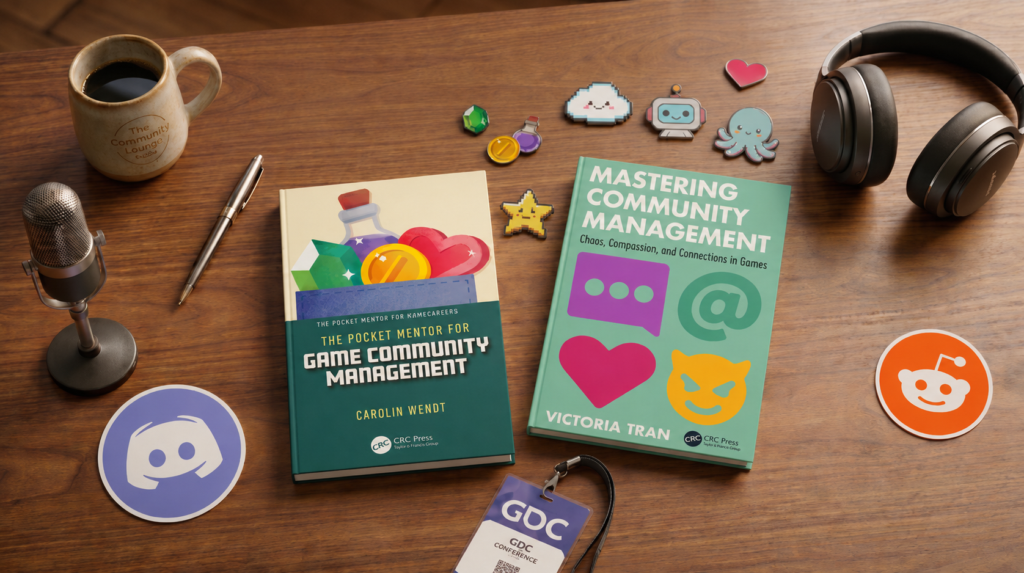
The Pocket Mentor for Game Community Management by Carolin Wendt
Carolin Wendt is a former Lead International Community at CD PROJEKT RED. Her book is part of the Pocket Mentors for Games Careers series at CRC Press. It is aimed at juniors and people trying to break into the field, covering roughly their first year in the profession. Four chapters are written by other community management professionals, and the book includes survey data gathered from community managers currently working in the field.
When I attended the Develop conference in Brighton, Carolin’s book kept coming up.
“When it came time for people to share ways to learn how to do the job better, your book was mentioned by like five people.” – Steve McLeod to Carolin Wendt (S01E08)
I told Carolin the book helped me understand the industry as an outsider.
“I’d like to say thank you myself for writing the book. It was like a crash course for me into the industry.” – Steve McLeod, S01E08
Carolin spent three months studying community management job listings worldwide before writing the book. She took screenshots, built spreadsheets, and distributed a survey across Discord servers and social media to gather input from community managers. The book is grounded in what the job actually looks like, not what someone imagines it should be.
“The Pocket Mentor for Game Community Management” book
Mastering Community Management by Victoria Tran
Victoria Tran is Games Communications Director at InnerSloth, the studio behind Among Us. Her book, Mastering Community Management: Chaos, Compassion and Connections in Games, is structured in two parts: an introduction to community management and its role, followed by guidelines for community management activities across all development phases (pre-production, launch, post-launch).
“I think that any discipline can be better at their work when they better understand all of the moving parts in a game. And community management tends to be one of those things that feels like a black box. And I hope that this book kind of unveils more of what happens specifically and what you can do.” – Victoria Tran (S02E11)
Nora Mattsson from Studio Downstairs (S02E07) mentioned pre-ordering Victoria’s book before it was even released, which tells you something about how the CM community views her work.
“Mastering Community Management” book
A book guests recommend
On Writing Well by William Zinsser
Victoria Tran recommended this classic nonfiction writing guide as relevant to community managers. Writing is a core part of the job, whether you are drafting patch notes, social media posts, or internal reports.
“There’s a lot of books out there. I think the book that I really like is called On Writing Well. I don’t remember the author. It’s a pretty famous book. But you know, it’s a whole topic. There’s so many books out there about writing and copywriting specifically.” – Victoria Tran (S02E11)
Newsletters and blogs
Victoria Tran’s Community Dev Newsletter
Victoria publishes a monthly newsletter on community management and game development. It was recommended by Gabriel Sanchewski (S01E03) and came up again in Victoria’s own episode (S02E11). Her website, victoriatran.com, is a hub for her articles, newsletter archive, and book information.
“Her newsletter (…), it’s really fun to read.” – Gabriel Sanchewski (S01E03)
Florian Rohde’s blog posts at YAGER
Florian Rohde, Community and Player Support Lead at YAGER, has written about the practice of community management on the YAGER company blog.
“Managing negative feedback and criticism with openness and understanding fosters an environment of open thought and idea exchange. (…) As community managers, we act as a filter for feedback, ensuring that constructive criticism reaches the appropriate teams while shielding our colleagues from unnecessary toxicity.” – Florian Rohde (S01E07)
Florian’s blog posts on being a community manager:
Free talks and courses online
GDC talks on YouTube
This was the single most recommended learning resource across the entire podcast. The Game Developers Conference publishes free recordings of conference talks on their official YouTube channel, including case studies and presentations on community management and marketing.
Henri Bazire (S02E08) was the most enthusiastic about them.
“The GDC talks (…) are a treasure. You have a lot of free videos on YouTube. (…) If you are looking for inspiration, new ideas, a fresh view on something, or case studies, it’s incredible to have such resources online and totally free.” – Henri Bazire (S02E08)
Sofia Pettersson from Apog Labs (S02E09) described them as the first thing her boss pointed her to.
“When I started, my closest boss gave me some suggestions for YouTube videos. They were recorded talks from GDC, especially about community. I listened to those and then found other videos as well.” – Sofia Pettersson (S02E09)
GDC Vault
Beyond the YouTube channel, the GDC Vault is a free online archive of GDC lectures and presentations. Ellinor Bergman (S01E06) and Nora Mattsson (S02E07) both recommended it.
“I’ve listened to this podcast and the GDC Vault and other YouTube channels like Game Maker’s Toolkit etc. They have great tips.” – Nora Mattsson (S02E07)
LinkedIn Premium learning
Kayla Goullaud, former Community Manager at Turn 10 Studios (S02E01), mentioned LinkedIn Premium’s learning platform as a way to take professional development classes relevant to community work.
“Even things like LinkedIn Premium, I think has a way to connect with other people in your industry to take their small classes or get information from them.” – Kayla Goullaud (S02E01)
Discord communities for CM professionals

The Break Room
The Break Room is a private, vetted Discord server for community managers working in the gaming industry, created and run by Gabriel Sanchewski (S01E03). It has 300+ members, and Gabriel reviews each application manually. It came up in more episodes than almost any other single resource, including S01E07, S02E02, and S02E04.
“The name of the server is ‘The Break Room’. I want to emulate that kind of environment of a break room, when you’re at work and you’re tired and it’s kind of crazy. (…) There’s a room that you can retreat to that is more calm, quiet. You can kind of relax a little bit.” – Gabriel Sanchewski (S01E03)
Florian Rohde (S01E07) described it as a place where CMs share practical knowledge.
“‘The Break Room’ is a great source of not only information, but also of talking through issues or problems with people who understand those exact problems. (…) There were some people sharing cool ideas of how you can make Steam forums much nicer and much cleaner for people that visit them.” – Florian Rohde (S01E07)
The Break Room (for community management professionals) application form.
SMCMG Discord
Gabriel Sanchewski also runs a second Discord server that is more open to the public, aimed at people who aspire to become community managers rather than only current professionals.
“The one that I posted actually is a different server, a different kind of server that is more open to the public and that server includes those who are aspiring community managers.” – Gabriel Sanchewski (S01E03)
SMCMG Discord (for aspiring community managers) application form – https://bit.ly/3xW5J0D
Chris Zukowski’s Discord
Nora Mattsson from Studio Downstairs (S02E07) recommended a Discord server run by Chris Zukowski, focused on game marketing.
“There’s Chris Zukowski, he has a Discord server, and many other game developers have the same questions as you. People there are very friendly.” – Nora Mattsson (S02E07)
Discord Admin Community
A large, semi-private Discord server run by Discord itself, for server administrators to learn from each other. It includes Discord employees and product team members.
“This is a server for admins to learn from each other and to get feedback. There are also Discord employees in this server as well.” – Gabriel Sanchewski (S01E03)
Conferences and events
Conferences came up constantly. Not just for the talks, but for the networking. Several guests described conferences as the single best way to meet other CMs and learn what works at other studios.
GDC (Game Developers Conference)
GDC is the benchmark industry event. It was referenced across multiple episodes (S02E08, S02E09, S01E08) both for its talks (which end up on YouTube) and for in-person networking.
“I haven’t yet been to GDC. A mentor tells me I really have to get there because it’s where business happens in the games industry.” – Steve McLeod, S02E08
Develop:Brighton
A UK game development conference with dedicated community management roundtables. This is where I heard Carolin Wendt’s book recommended five times in one day. It also includes the Game Dev Heroes awards, a peer-nominated ceremony that Jarvs Tasker (S03E01) praised.
“There’s a fringe award show at Develop. It’s called Game Dev Heroes. (…) I have watched that on LinkedIn, and looked at what the amazing people are doing in the games industry.” – Jarvs Tasker (S03E01)
Game Quality Forum
Florian Rohde (S01E07) recommended this event specifically for its dedicated community management track.
“Visit things like the Game Quality Forum, where you have a community track, where community management tools are shared, and where people from community management share their experiences in talks or panel discussions.” – Florian Rohde (S01E07)
Gamescom
The largest gaming event in Europe, held annually in Cologne, Germany. It was mentioned by Christian Jurgensen (S01E05), Carolin Wendt (S01E08), and Thomas Schramm (S02E03) as a place for community events and meeting other CMs.
Digital Dragons
A B2B gaming conference in Krakow, Poland. Gabriel Sanchewski (S01E03) credits it with landing him his first in-house community manager position.
“There was this conference, Digital Dragons, that I mentioned in 2017. (…) I was sending my resume out to different companies and one of the companies that I sent my resume to had a booth at Digital Dragons.” – Gabriel Sanchewski (S01E03)
Other conferences mentioned
- Swedish Game Conference: Jeremy Fielding (S01E02) participated in panels with CMs from Irongate and Coffee Stain.
- Nordic Game: A conference I’ve attended twice.
- SGF (Summer Game Fest): Carolin Wendt (S01E08) described attending to “meet other community managers, see how the community initiatives are on there.”
Mentorship programs
Limit Break
A UK-based mentorship program connecting underrepresented people with mentors across the games industry, from voice acting to community management.
“Limit Break is a place for disadvantaged people to find a mentor to help them in their chosen career. This is predominantly within gaming, but it is almost every avenue within the gaming sphere.” – John Lloyd (S03E03)
Website: Limit Break
Staying current with Reddit
James Croucher (S01E01) described using Reddit as a daily learning habit to keep up with industry news and player sentiment.
“I personally just try and keep an eye on what’s going on in the world. I use a lot of Reddit, which aggregates a lot of the key posts and the key goings on in the industry.” – James Croucher (S01E01)
Subreddits he recommended: r/pcgaming, r/games, r/gamedev, and r/gamedeveloper.
James Croucher (S01E01) also likes Deep Rock Galactic’s Reddit community, calling their community team one of the best in the world. What sets them apart is that team members from multiple departments, not just the CM, actively engage with the community.
“Deep Rock Galactic, I think, has one of the best community teams and maybe development teams in the world at the moment. (…) They pushed me to want to get onto Reddit as a whole based on how they approached the platform.” – James Croucher (S01E01)
What I noticed across all these conversations
One thing stood out as I put this list together. The community managers I interviewed did not learn from a single course or a single book.
They learned from a mix of things: a GDC talk that shifted how they thought about player feedback, a Discord server where a peer shared a trick for managing Steam forums, a conference where they met someone who became a mentor.
The other pattern is that the people who keep getting better at this job tend to stay connected to other community managers.
Every resource on this list, whether it is a book, a Discord server, or a conference, is really just a different way of doing the same thing: learning from someone who has been where you are.
If you are new to community management and not sure where to start, the two lowest-barrier entries on this list are probably the free GDC talks on YouTube and Gabriel Sanchewski’s SMCMG Discord for aspiring CMs. One gives you knowledge. The other gives you people to talk to about it. Both are free.
And if you want to hear the full stories behind these recommendations, all episodes of The Community Lounge are available to listen to.
Related guides
Practical, step-by-step advice to help you manage, thrive and grow.
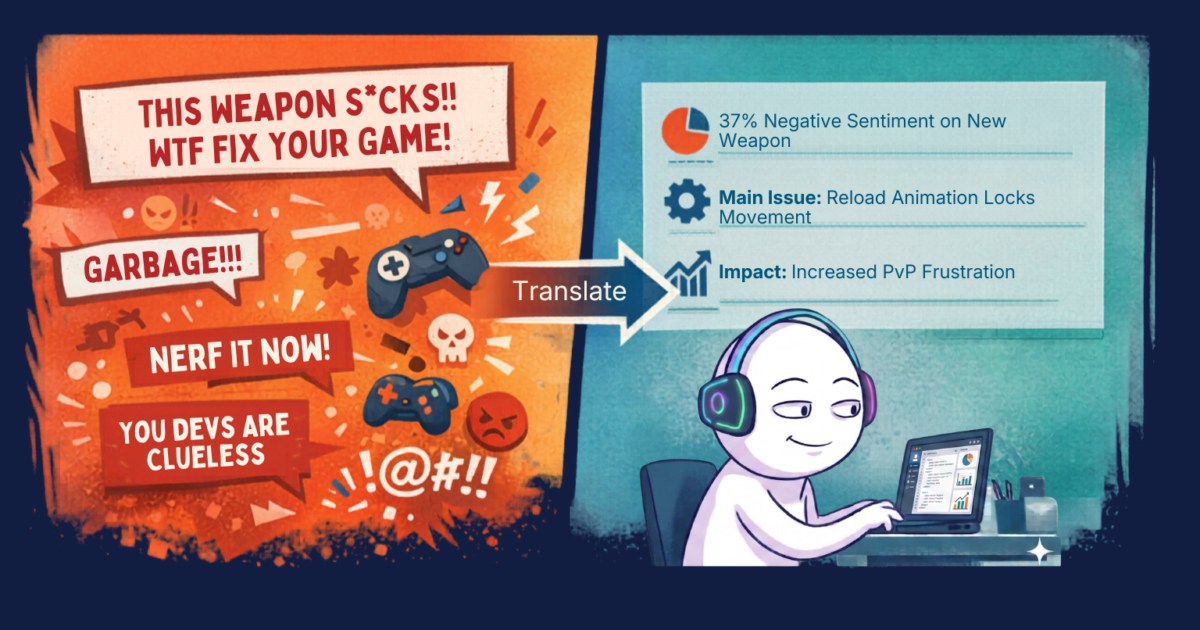
Internal communication for community managers: How to talk to your team
In this guide, we explore the invisible half of community management: internal communication. Learn how to build trust with developers, tailor your reports for different stakeholders, filter out toxicity, and translate studio decisions to your players with empathy and transparency.
Your first week as a community manager: What actually matters
Starting a community management role feels like being handed the keys to someone else’s house while they’re on vacation. You know there’s a system, but nobody left instructions. The good news: every community manager before you felt the same disorientation. The better news: there are concrete things you can do in week one that will […]
Burnout: How community manager veterans are dealing with it
Burnout in community management isn’t theoretical. It’s the 3am Discord notification you can’t ignore. It’s the death threat over a balance patch. It’s the slow erosion of loving your job into dreading your inbox. I’ve interviewed dozens of community managers for The Community Lounge podcast. Here’s what they’ve actually said about burning out, fighting it, […]